How to Cover Up an Old Tattoo: What Works and How to Plan It
Can your old tattoo be covered up? Learn which tattoos cover well, which designs and colors hide old ink, when to fade it with laser first, and how to plan a cover-up with your artist.
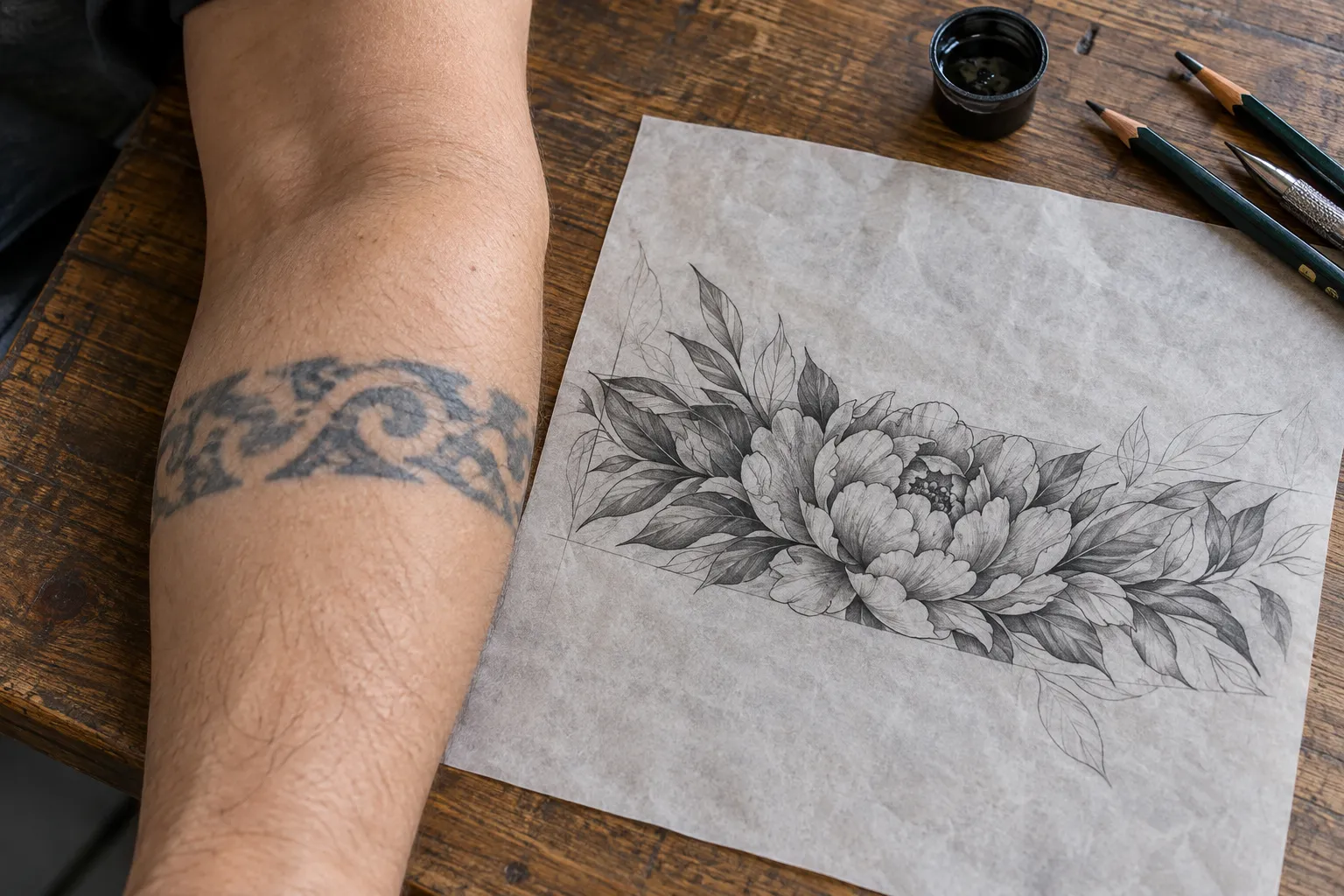
Most old tattoos can be covered up. A cover-up tattoo is a new design placed directly over an existing one, built so that its darker, denser areas sit on top of the old ink while lighter areas spread onto clean skin. It works best when the old tattoo is faded or light, and when you accept a new design that is larger and darker than the one you have now. Very dark, heavily saturated, or very large tattoos often need a few laser sessions first to lighten them.
The short answer:
- Take an honest look at the old tattoo: how dark, how big, and where it sits.
- Accept the three trade-offs: the new tattoo will be larger, darker, and different from what you would design on clean skin.
- Choose a subject with natural dark areas and texture, such as flowers, animals, or Japanese motifs.
- Fade the old ink with laser first if it is dark, solid, or very large.
- Book a consultation with an artist who has cover-ups in their portfolio.
- Preview a few directions on a photo of your tattoo before you commit.
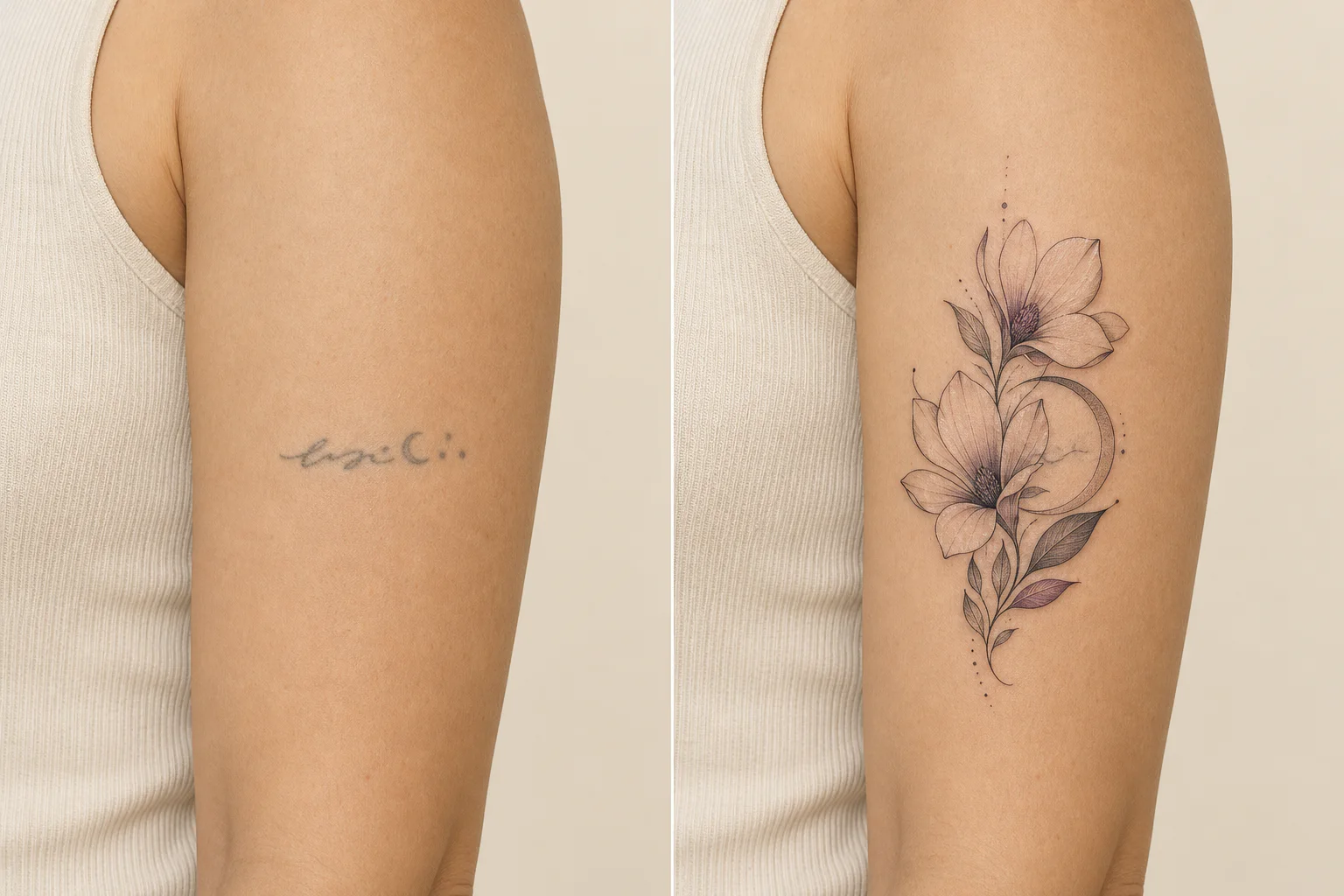
A faded script planned under shaded magnolia petals. This image, the cover, and the other examples in this guide are AI-generated illustrations of cover-up concepts, not real clients or healed tattoos.
How a cover-up tattoo works
New tattoo ink does not erase old ink. Both sit in the skin at the same time, and the darker pigment shows through the lighter one. A cover-up therefore hides the old tattoo by camouflage, not by painting over it:
- The darkest parts of the new design (shadows, deep petals, fur, scales, black fills) are placed exactly over the old lines.
- Texture and detail around those areas break up the old shapes, so the eye no longer reads them.
- Lighter areas and open skin extend beyond the old tattoo, which keeps the new piece from looking like a solid patch.
That is why a good cover-up starts from the old tattoo, not from a design you already have in mind. The old ink decides where the darkness has to go.
Can your tattoo be covered up?
How easy a cover-up is depends mostly on how dark, how dense, and how big the old tattoo is. Use this as a first check before you talk to an artist:
| Old tattoo | How easy it is to cover | What usually helps |
|---|---|---|
| Faded, light, or blurry lines | Easy | Most subjects and styles work |
| Thin script, small symbols, fine line | Easy to moderate | A design with shading over the letters |
| Medium-sized outlines with some fill | Moderate | A larger design with dark areas placed over the fill |
| Bold black tribal, solid black fill | Hard | Laser fading first, or a darker style such as blackwork |
| Large, saturated color pieces | Hard | Laser fading first, then a bigger design |
| Recent tattoo that is still healing | Not yet | Wait until it is fully healed |
Placement matters too. A small tattoo on the forearm, calf, back, or upper arm leaves room to grow. A tattoo on a finger, an ankle bone, or a narrow wrist has little space around it, which limits how large and detailed a cover-up can be.
The three trade-offs of every cover-up
Being realistic here is what separates a cover-up you love from one you regret.
1. It will be bigger. The new design has to fully contain the old one and still have room for detail and open skin around it. Expect a noticeably larger piece than the tattoo you have now.
2. It will be darker. Something has to sit over the old lines, and that something is dark ink. Light, airy, or mostly empty designs can't hide much on their own.
3. Your design choices are narrower. Very minimal line art, pale watercolor, and lots of empty skin are hard to use over old ink. You choose from designs that can carry density where the old tattoo is.
If these trade-offs don't suit you, look at the alternatives further down the page, such as laser fading first or a rework.
Which designs and colors cover old ink best
Subjects that cover well
Good cover-up subjects have natural dark areas and plenty of organic texture that can be shaped around the old tattoo:
- Flowers, especially peonies, roses, chrysanthemums, and magnolias, with deep petal centers and overlapping leaves.
- Animals with fur, feathers, or scales, such as wolves, owls, ravens, panthers, koi, and snakes.
- Japanese motifs like koi, waves, wind bars, and maple leaves, which are built on bold shapes and dark backgrounds.
- Mandalas and ornamental pieces with dense centers, for small, round, or symmetrical old tattoos.
- Blackwork, dotwork, and geometric patterns for tattoos that are too dark to hide any other way.
Subjects that struggle are those with large areas of open skin, very thin lines, or light colors: minimal line art, single-needle script, and soft watercolor washes.
Colors that cover well
Ink is slightly translucent, so a lighter color cannot hide a darker one. Black, dark grey, navy, deep purple, dark green, and deep red cover best. Yellow, light pink, pale blue, and white will let the old ink show through. Color can still appear in a cover-up, but it usually works as an accent next to the dark structure, not as the layer that hides the old lines.
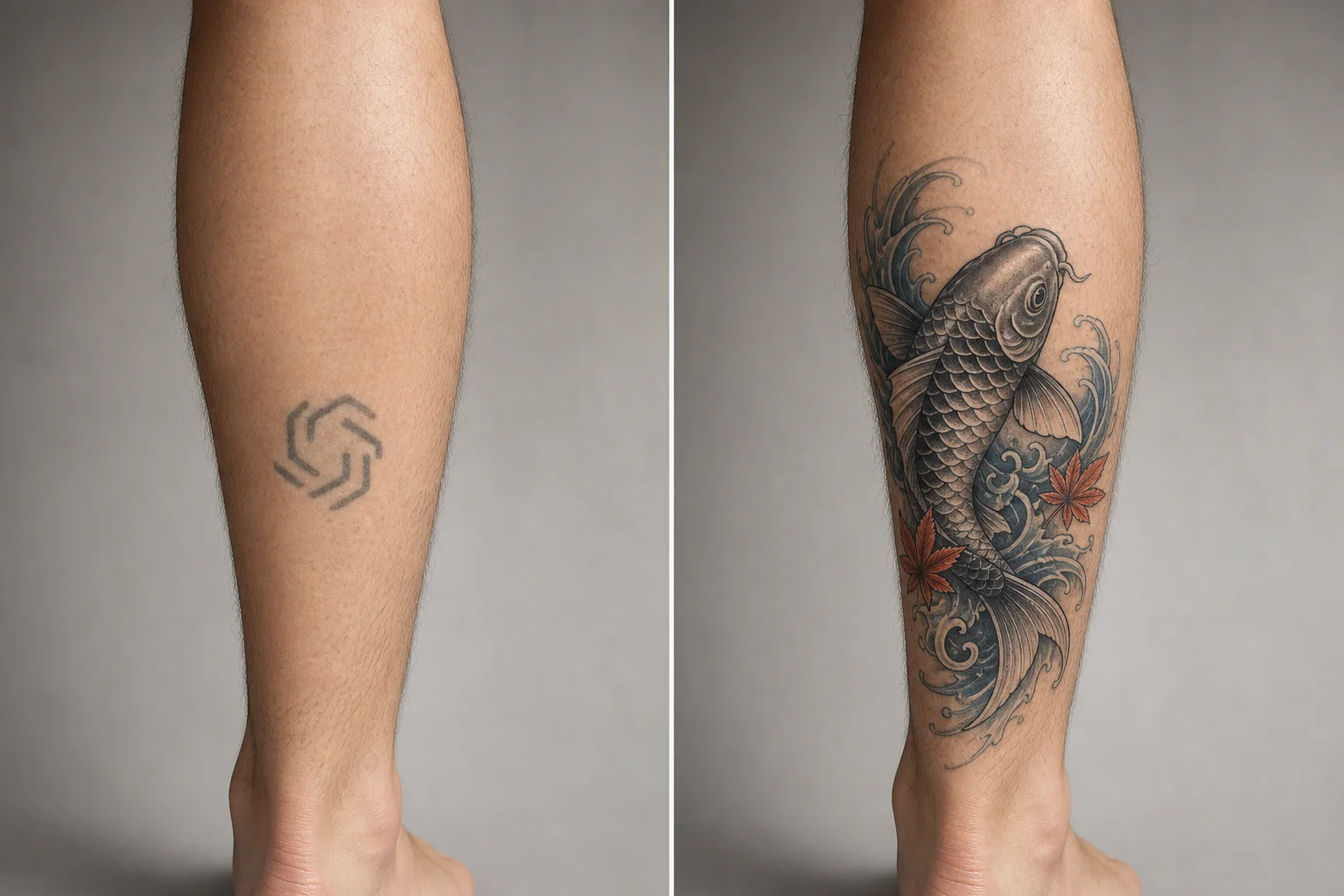
A compact emblem becomes the shaded body of a koi, while maple leaves and water spread onto clean skin. AI-generated illustration of a concept, not a real result.
Should you fade the old tattoo with laser first?
Laser fading (sometimes called lightening) means a few laser removal sessions to make the old tattoo lighter, not to remove it completely. It is worth considering when:
- the old tattoo is very dark, solid black, or heavily saturated;
- you want a lighter style, more color, or more open skin than the old ink would allow;
- the old tattoo is so large that covering it fully would mean a much bigger piece than you want.
Fading usually takes fewer sessions than full removal, and each session needs time to heal before the next one. A laser clinic can tell you how many sessions your tattoo is likely to need. Your cover-up artist can tell you how light it needs to be for the design you want, so it helps to ask both.
Cover-up alternatives
A full cover-up is not the only way to deal with a tattoo you no longer like:
| Option | What it does | Best for |
|---|---|---|
| Cover-up | A new, larger design camouflages the old one | Most faded or medium tattoos you want to replace |
| Laser fading + cover-up | Lightens the old ink, then covers it | Dark, solid, or large tattoos; lighter or more colorful cover-ups |
| Rework or refresh | Keeps the old tattoo and improves its lines, shading, and color | A tattoo you still like that has aged or blurred |
| Blast-over | A new bold design over the old one, without fully hiding it | People who like a layered, collage look |
| Full laser removal | Removes as much of the ink as possible | When you want clean skin, no new tattoo |
| Blackout | Fills the area with solid black | Very dark old work, often on arms and legs |
How to plan a cover-up, step by step
Step 1: Photograph the old tattoo properly
Take a clear photo in soft, even daylight, straight on, with no filter. Include the whole tattoo and some skin around it, so you can see how much space there is. This photo is the starting point for every conversation and preview.
Step 2: Note what the cover-up needs to solve
Write down the darkest parts of the old tattoo, how big it is, and any areas that have blown out or blurred. Then list what you would like the new tattoo to be about. A cover-up is easier when you are open to a few subjects instead of one fixed idea.
Step 3: Explore a few directions
Before you book, explore how different subjects could sit over your actual tattoo. With the TattooIdeas AI Tattoo Cover-Up tool, you upload a photo of the old tattoo and mark the area. The AI looks at how dark and how large the visible ink is, then suggests four different cover-up directions for free. You can then generate a preview of one direction on your own photo.
Use these previews as a brief for your artist, not a final design. An AI preview can't see pigment depth, scarring, or how your skin takes ink.
Step 4: Find an artist who does cover-ups
Cover-ups are a specialty. Look for an artist whose portfolio shows cover-ups with before-and-after photos, ideally in the style you want. Bring your photo, your notes, and any previews to the consultation, and be ready for honest feedback. A good artist may suggest a different subject, a larger size, or laser fading first.
Step 5: Check the size and placement
A cover-up is usually bigger than you expect, so preview the final size on your body before the appointment. A virtual tattoo try-on lets you place and scale a design on a photo of the body area, so you can see whether you're comfortable with how much skin it will take.
Step 6: Plan for more than one session
Larger cover-ups often take more than one session. The artist may lay down the dark structure first and add detail and color after it heals. Ask how many sessions they expect, and follow their aftercare advice between them.
Common cover-up mistakes
- Insisting on a specific design that has no dark areas where the old tattoo is.
- Going too small to save skin, which leaves the old tattoo peeking through.
- Choosing light colors over dark ink and expecting them to hide it.
- Skipping laser fading for a very dark tattoo, then running out of design options.
- Picking an artist without cover-up experience because they are available sooner.
- Rushing while the old tattoo, or a recent laser session, is still healing.
Frequently asked questions
Can any tattoo be covered up?
Most tattoos can be covered up with the right design, size, and artist, but not every tattoo can be covered with any design you like. Faded and light tattoos give you the most freedom. Very dark, solid, or large tattoos usually need laser fading first, or a darker style such as blackwork.
How much bigger does a cover-up tattoo need to be?
It depends on how dark and dense the old tattoo is, but a cover-up is almost always larger than the original. The new design has to contain the whole old tattoo and still have room for detail and open skin around it. Your artist will recommend a size after seeing the tattoo in person.
Can you cover a black tattoo with a lighter color?
No. Tattoo ink is slightly translucent, so a lighter color will not hide darker ink beneath it. Old black lines are covered with black, dark grey, or other deep colors. Lighter colors can be used around them as accents.
Do I need laser removal before a cover-up?
Not always. Faded and medium tattoos can usually be covered directly. A few laser fading sessions help when the old tattoo is very dark, solid black, or large, or when you want a lighter, more colorful cover-up than the old ink would allow.
Does a cover-up hurt more than a regular tattoo?
A cover-up is tattooed the same way as any other tattoo, but it is usually larger and denser, so the session can feel longer. Pain depends mostly on placement and session length. Your artist can tell you what to expect for your placement.
How can I see what a cover-up would look like before I commit?
Upload a clear photo of the old tattoo to an AI cover-up tool to explore a few directions on your own photo, then bring your favorite to an artist. You can also ask the artist to sketch over a printed photo of your tattoo, which is how many cover-ups are planned.