Upload and contain all old ink
Use neutral lighting and a regular rectangle around the complete tattoo, with room for a larger design.
REDESIGN THE OLD INK WITH CONTEXT
Upload an old tattoo photo, get four free AI cover-up directions, then generate one private preview for 4 credits.
The result retains photo context for comparison with the old tattoo. It is a discussion direction—not a final stencil or guarantee of a healed result.
 BEFOREAI CONCEPT
SYNTHETIC WORKFLOW DEMO
The public visual below is AI-generated—not a client or healed result. Upload and set the selection to get four free directions; one private generated preview costs 4 credits.
MADE FOR A REAL TATTOO DECISION
A credible flow analyzes the visible old ink and available redesign space before you choose a direction. Only the selected brief becomes an inpainted photo preview—it is not a generic text-to-image prompt with “cover-up” added.
Use neutral lighting and a regular rectangle around the complete tattoo, with room for a larger design.
AI assesses visible density, footprint, body flow, and selection margin, then proposes four different structures.
Selection fills the subject, style, color, and detail controls; you can still edit them before generation.
Spend 4 credits on one private photo preview, then ask an artist to assess pigment, skin, size, and feasibility.
SYNTHETIC WORKFLOW DEMONSTRATIONS
Each demonstration exposes four possible directions, the selected strategy, and the problems an artist would still need to solve. This shows the planning method without presenting an attractive AI image as proof of a real tattoo outcome.
Transparent by design: these are not client cases.All before-and-after visuals are AI-generated illustrative demos—not real client results, healed tattoos, or coverage guarantees.
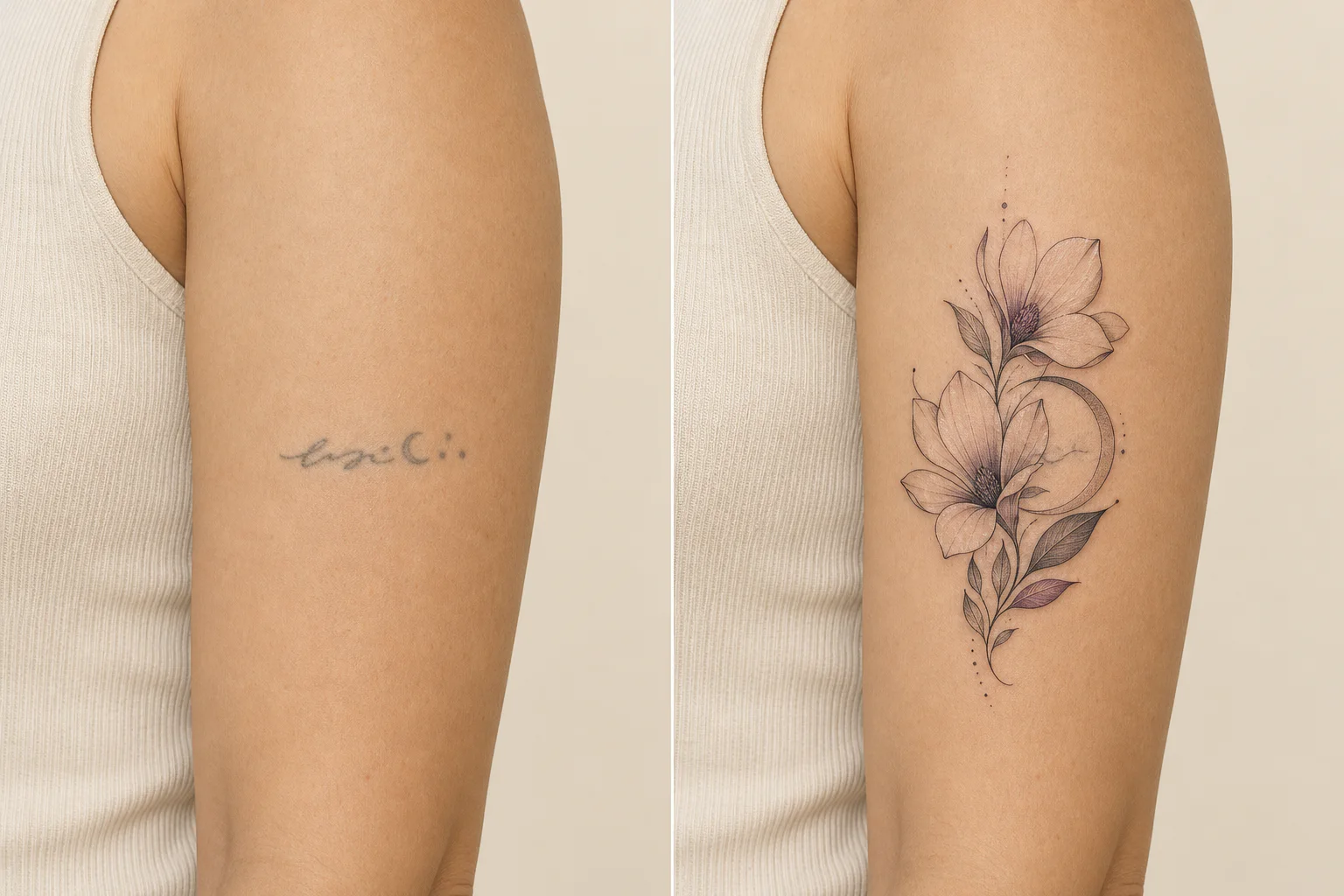
BEFOREAI CONCEPTDEMO 01
A light, narrow script can be absorbed by deliberately shaded floral details while the rest of the composition stays airy, curved, and jewelry-like.
VISIBLE OLD-INK ASSESSMENT
The old script appears light to medium in value, with a narrow footprint and a few darker overlaps near its center. It needs targeted mid-to-dark detail, not a continuous black field.
Four directions the free analysis could explore
SELECTED FOR THIS DEMO
Magnolia crescent
Place the shaded petal bases and darkest leaf overlaps over the old letters, then extend lighter linework into clean skin.
Why this direction may work
Petal bases and overlapping leaves create several separate coverage zones without merging into a black mass. The crescent follows the arm while muted color and open linework keep it elegant.
What still needs in-person work
 BEFOREAI CONCEPT
DEMO 02
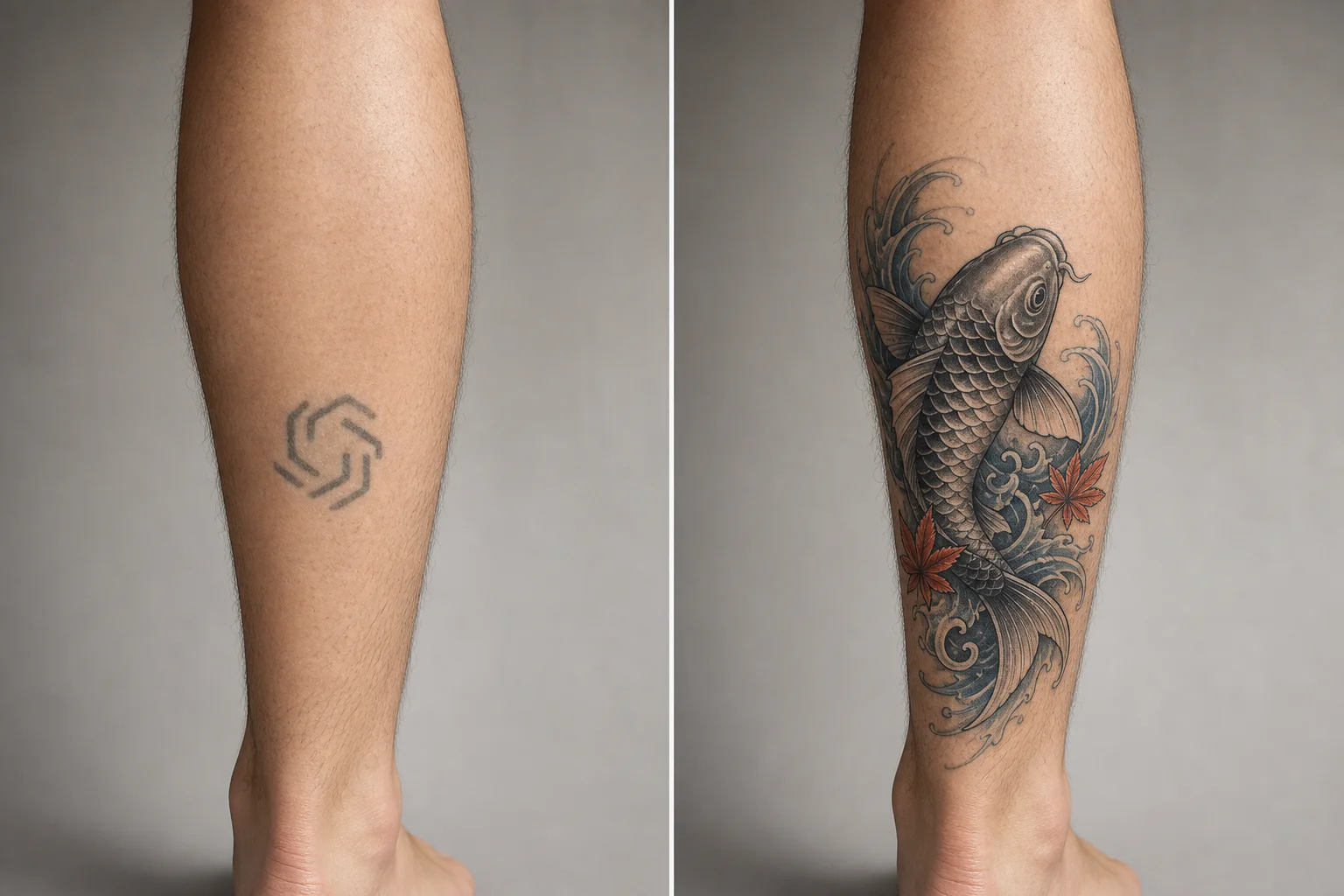
A compact medium-value emblem can become the shaded core of a flowing Japanese composition instead of being buried beneath a solid dark patch.
VISIBLE OLD-INK ASSESSMENT
The old emblem appears medium in value and compact, with darker intersections near its center and lighter angular arms. It needs one structured dark anchor plus flowing elements across the outer lines.
Four directions the free analysis could explore
SELECTED FOR THIS DEMO
Koi, maple, and water
Place the koi shoulder and deepest scale pockets over the old center, then cross lighter outer lines with maple shadow and a dark water turn.
Why this direction may work
The koi creates small, intentional dark pockets exactly where coverage is needed, while open water, warm maple color, and clean skin breaks keep the composition lively rather than dense.
What still needs in-person work
 BEFOREAI CONCEPT
DEMO 03
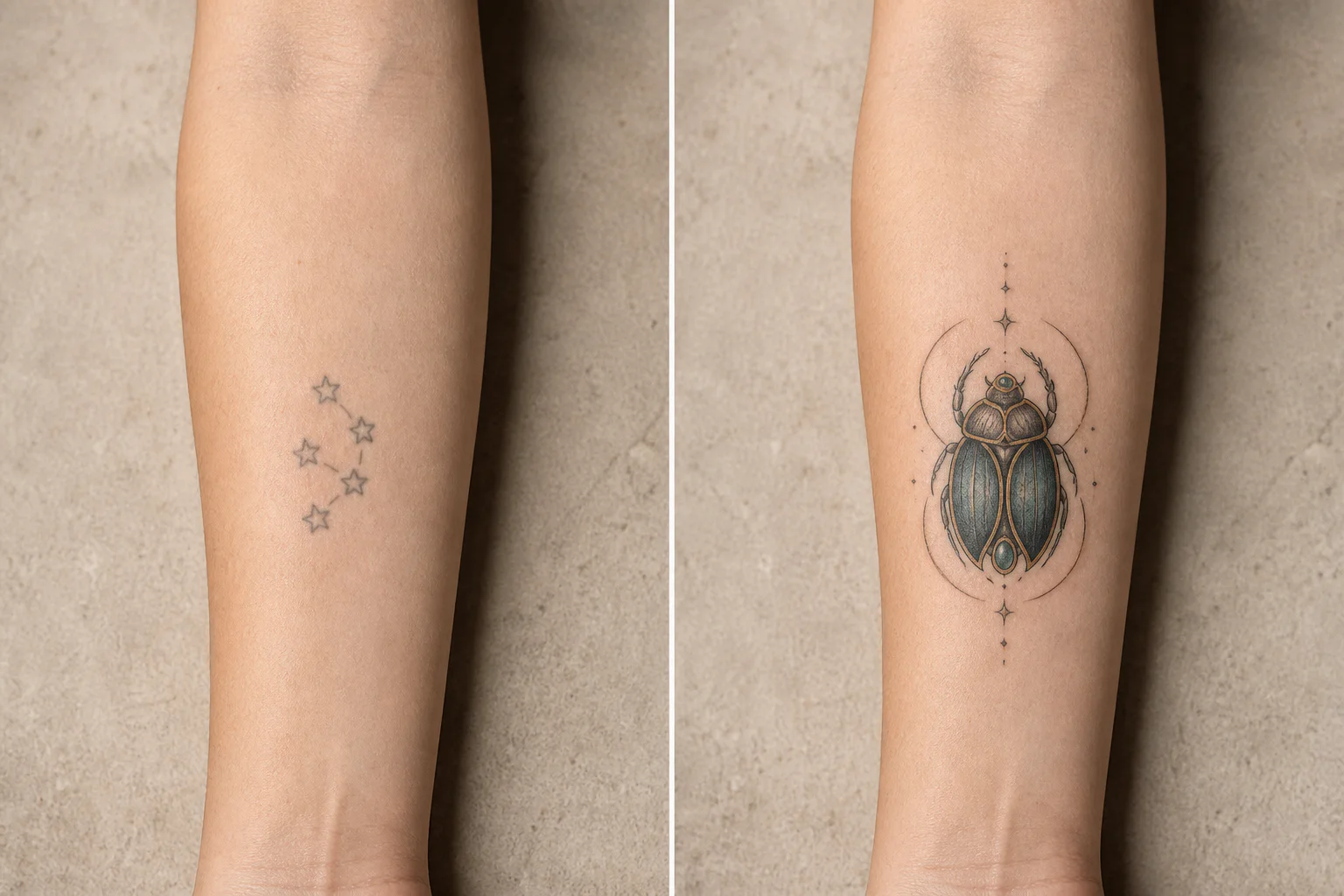
A small cluster of faded stars can map naturally into an ornamental focal form with precise symmetry, muted color, and generous clean skin.
VISIBLE OLD-INK ASSESSMENT
The old tattoo appears light to medium in value, with short star points and connecting strokes inside a compact oval. The center needs direct coverage while lighter tips can become ornament.
Four directions the free analysis could explore
SELECTED FOR THIS DEMO
Jeweled scarab
Center the dark thorax and inner wing shadows over the stars, keeping decorative arcs outside the old-ink footprint.
Why this direction may work
The compact thorax matches the old footprint while separated wing cases provide coverage without a solid oval patch. Muted teal, fine celestial lines, and symmetry add polish where heavy coverage is not needed.
What still needs in-person work
OUR PLANNING CHECKLIST
These checks help screen an AI concept. They do not replace an in-person artist or reveal real pigment depth and skin condition.
EXECUTION LIMITS
Darker, denser, or larger old tattoos usually constrain the executable options. AI cannot read actual pigment depth or guarantee that a new design will fully cover it.
It uses the visible ink density, shape, body direction, and redesign rectangle to suggest four different subjects and coverage structures. Analysis uses no credits; after you choose a direction, one private generated preview costs 4 credits. It remains visual planning—not a professional diagnosis of skin or pigment.
No. The tool creates a visual preview but cannot measure pigment depth or determine real application conditions. Ask an artist with cover-up experience to assess it in person; consult a qualified healthcare professional if you have concerns about the skin itself.
Everything inside the rectangle is the inpainting mask, while the outside preserves the original photo context. Enclose the entire old tattoo with extra room instead of tracing its outline. Minor transitions may still appear at the boundary, so treat the result as a preview.
Yes. When you generate, one normalized WebP source—or a PNG fallback when WebP encoding is unavailable—is saved privately, and a successful result is saved separately. A saved source is retained for troubleshooting even if generation fails or is canceled; failed-generation credit refunds are unaffected. Delete a completed project to remove its files, or contact support to delete a failed or canceled job’s source. The temporary provider PNG and mask are not saved as project files.
Larger, connected styles with intentional mid-to-dark masses often offer more coverage options—such as blackwork, Japanese, traditional, and neo-traditional. Fine-line work or large skin breaks may not suit dense old ink. An artist must make the final choice after seeing the real pigment.