PATCHWORK SLEEVE TATTOO IDEAS
72 patchwork sleeve tattoo ideas that feel collected, not chaotic
A patchwork sleeve grows from separate tattoos rather than one continuous background. The freedom is the appeal, but spacing, scale, contrast, and a few repeated visual rules are what make the arm read as an intentional collection.
72 CURATED PATCHWORK CONCEPTS
Explore 72 ways to build a patchwork sleeve
These AI concept visualizations are planning references, not tattoo-ready artwork. Filter by style, theme, or arm zone, then ask a professional tattoo artist to redraw any favorite for your anatomy, placement, and tattoo-safe linework.
72 design directions
Page 1 of 3
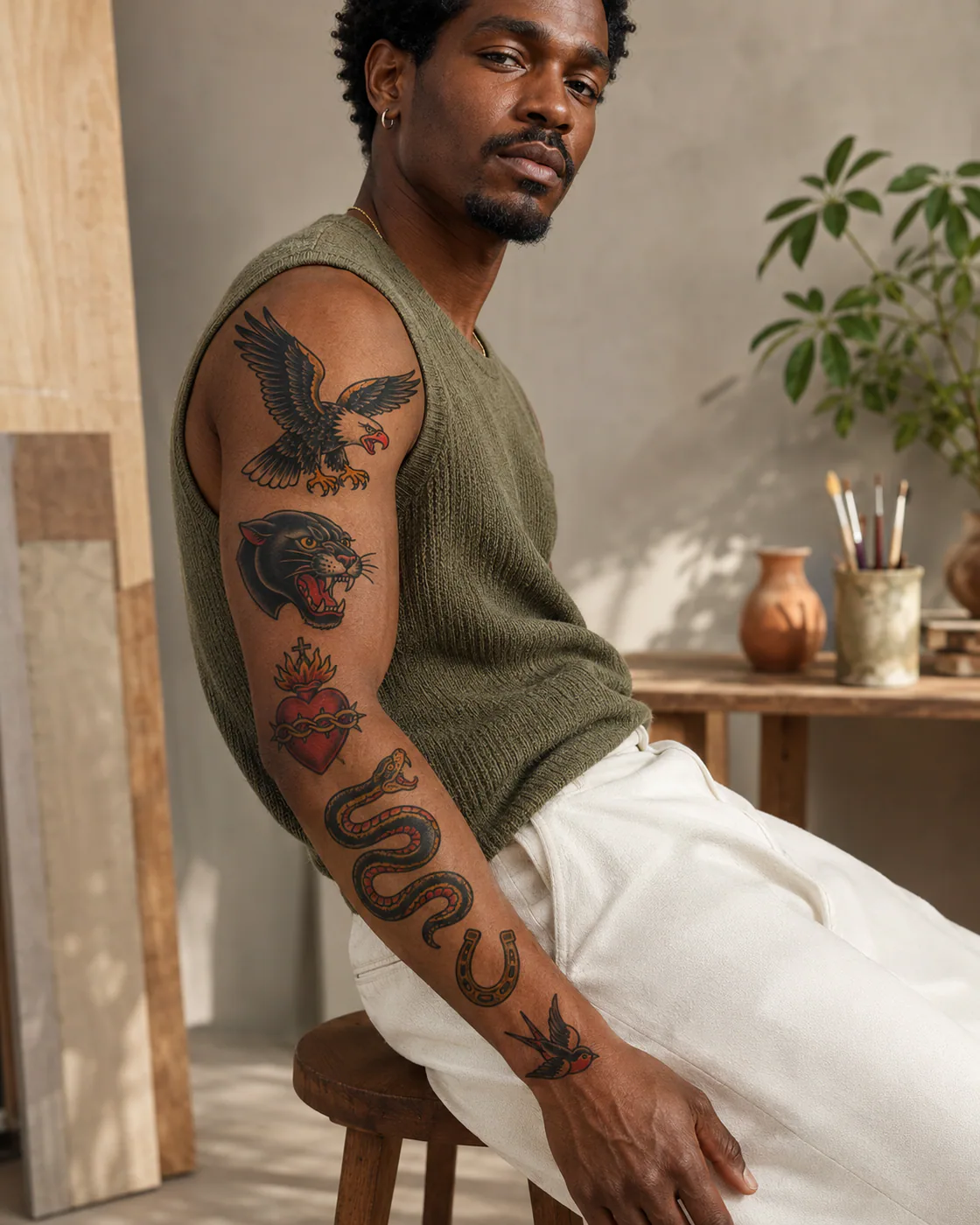
Eagle and panther heritage sleeve
Bold black outlines and a restrained red-gold palette unite several classic flash subjects without closing the skin gaps.
- American Traditional
- Animals
- Full sleeve
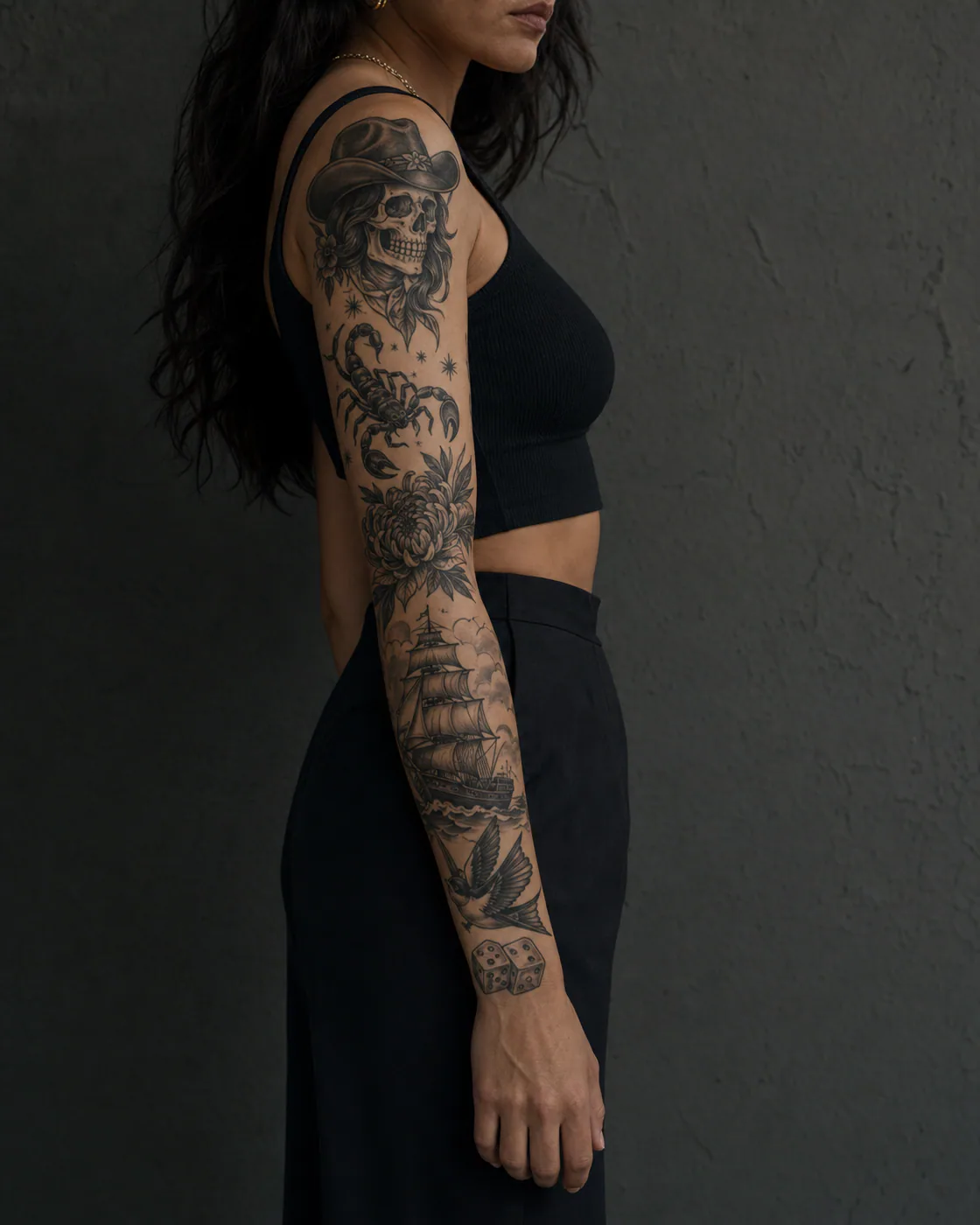
Cowgirl and scorpion story sleeve
Western attitude meets maritime flash in a darker collection balanced by one large floral anchor.
- American Traditional
- Western
- Full sleeve
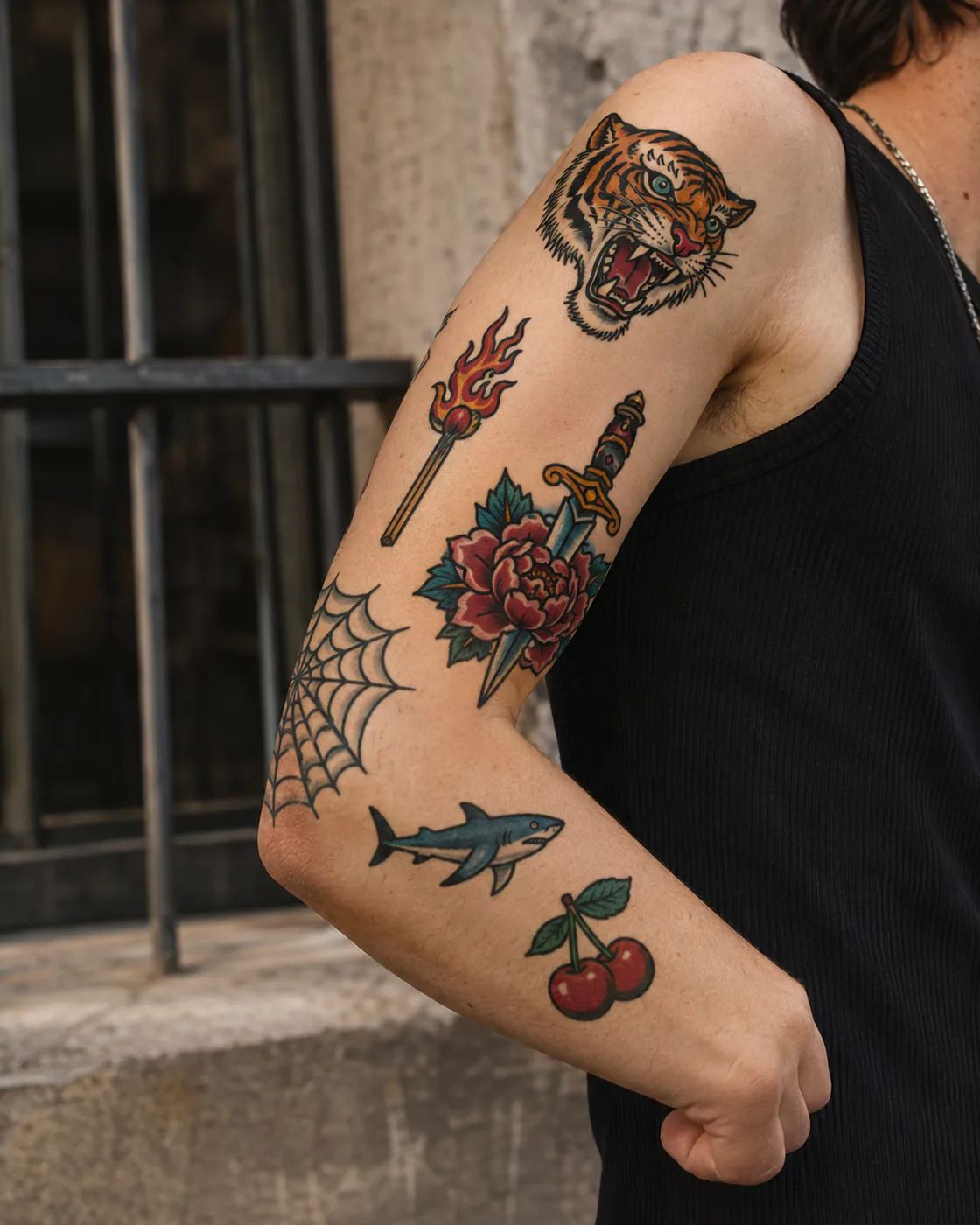
Tiger and peony elbow composition
The bent-arm view shows how round flowers and a web can negotiate the elbow between stronger vertical anchors.
- American Traditional
- Animals
- Full sleeve
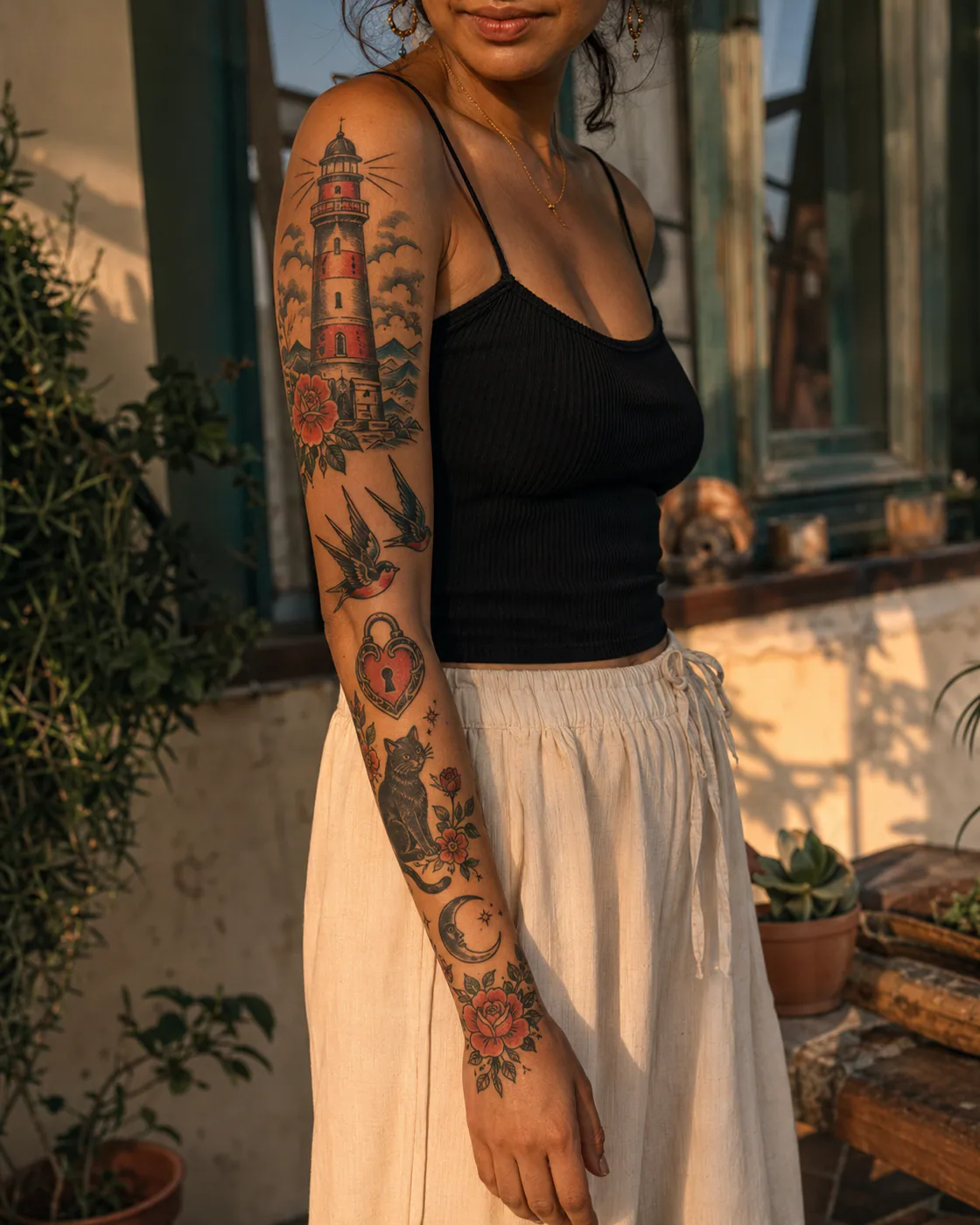
Lighthouse and black cat collection
A tall lighthouse controls the forearm rhythm while the cat and small symbols taper naturally toward the wrist.
- American Traditional
- Nautical
- Full sleeve
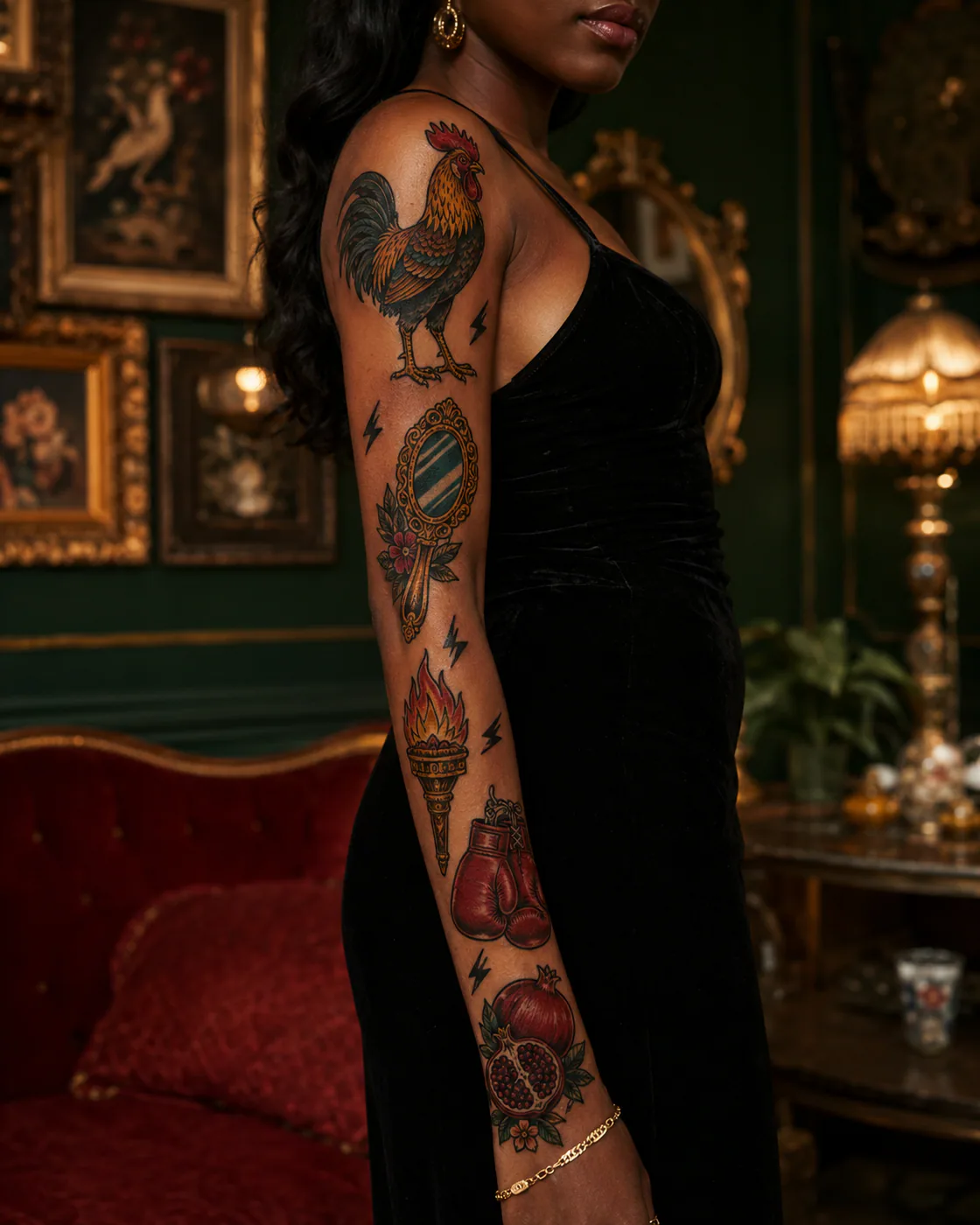
Rooster and mirror vintage sleeve
Distinct domestic and fighting symbols share one vintage palette, creating variety without losing visual kinship.
- American Traditional
- Animals
- Full sleeve
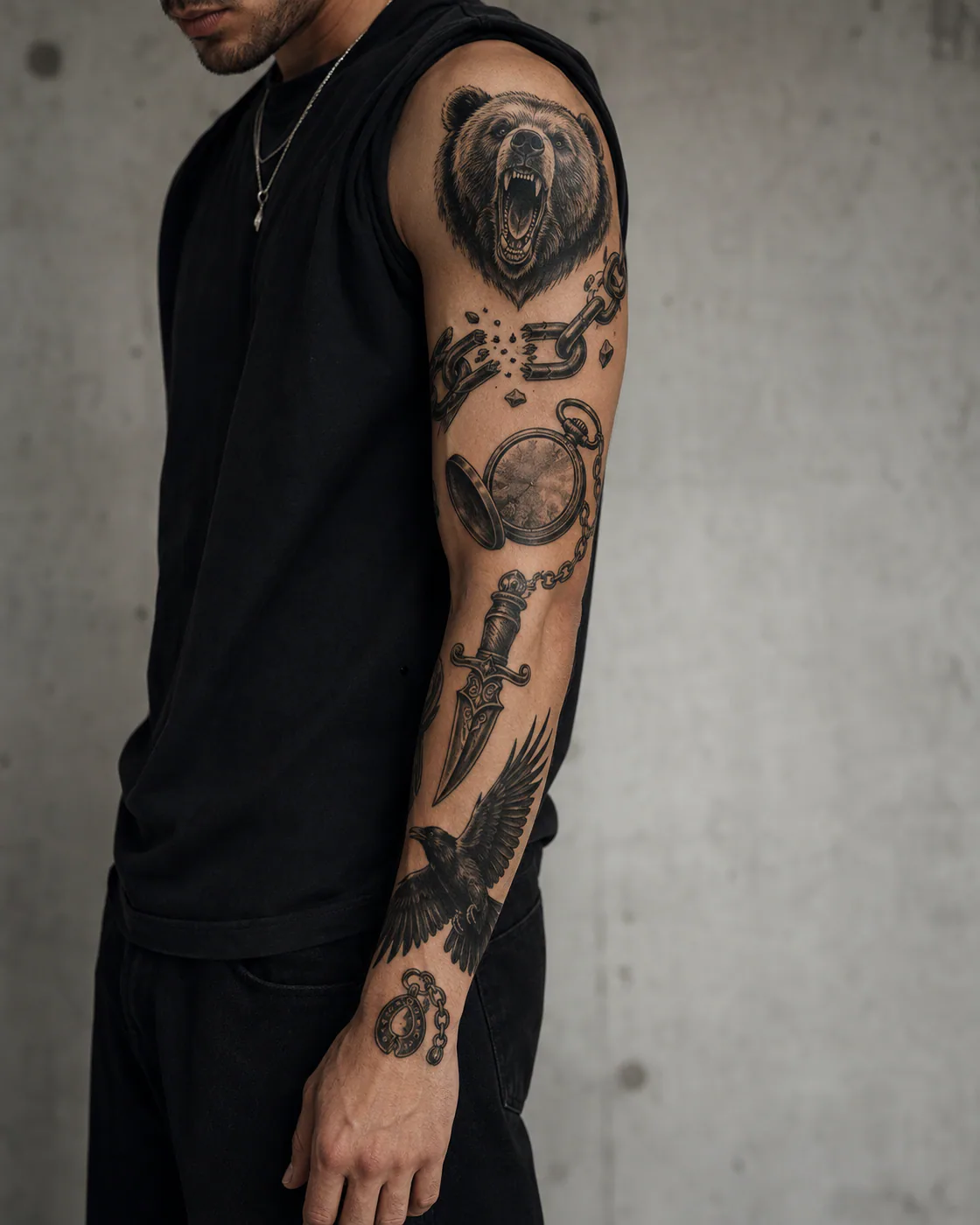
Bear and broken-chain black sleeve
Heavy animal shapes establish the upper arm while narrow objects keep the lower sleeve from feeling blocky.
- American Traditional
- Animals
- Full sleeve

Colorful coastal patchwork sleeve
Small coastal subjects repeat turquoise and rust accents so the colorful sleeve stays coordinated around the arm.
- American Traditional
- Nautical
- Full sleeve
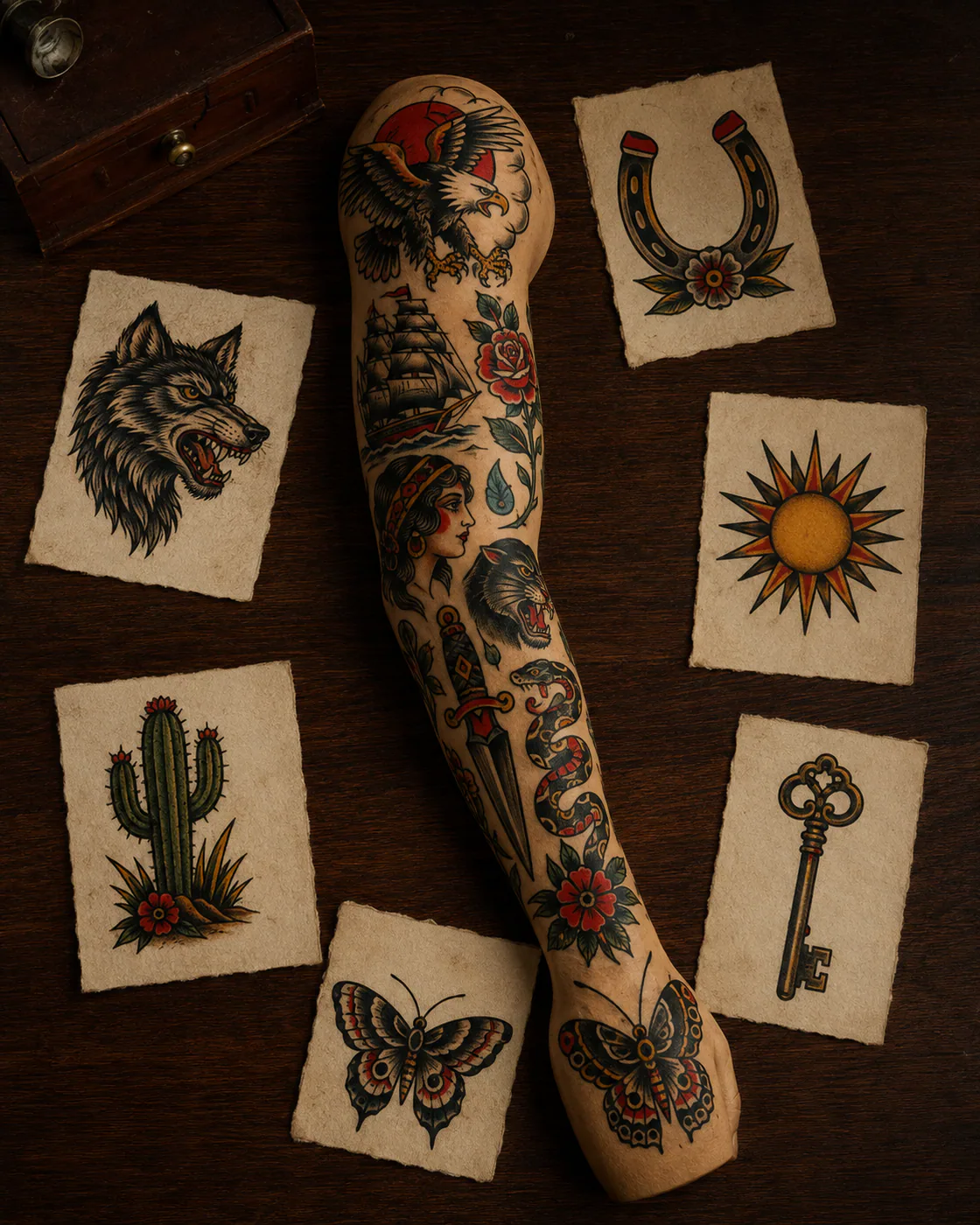
Traditional flash layout study
A planning-board view tests scale and rotation before individual traditional pieces are committed to skin.
- American Traditional
- Animals
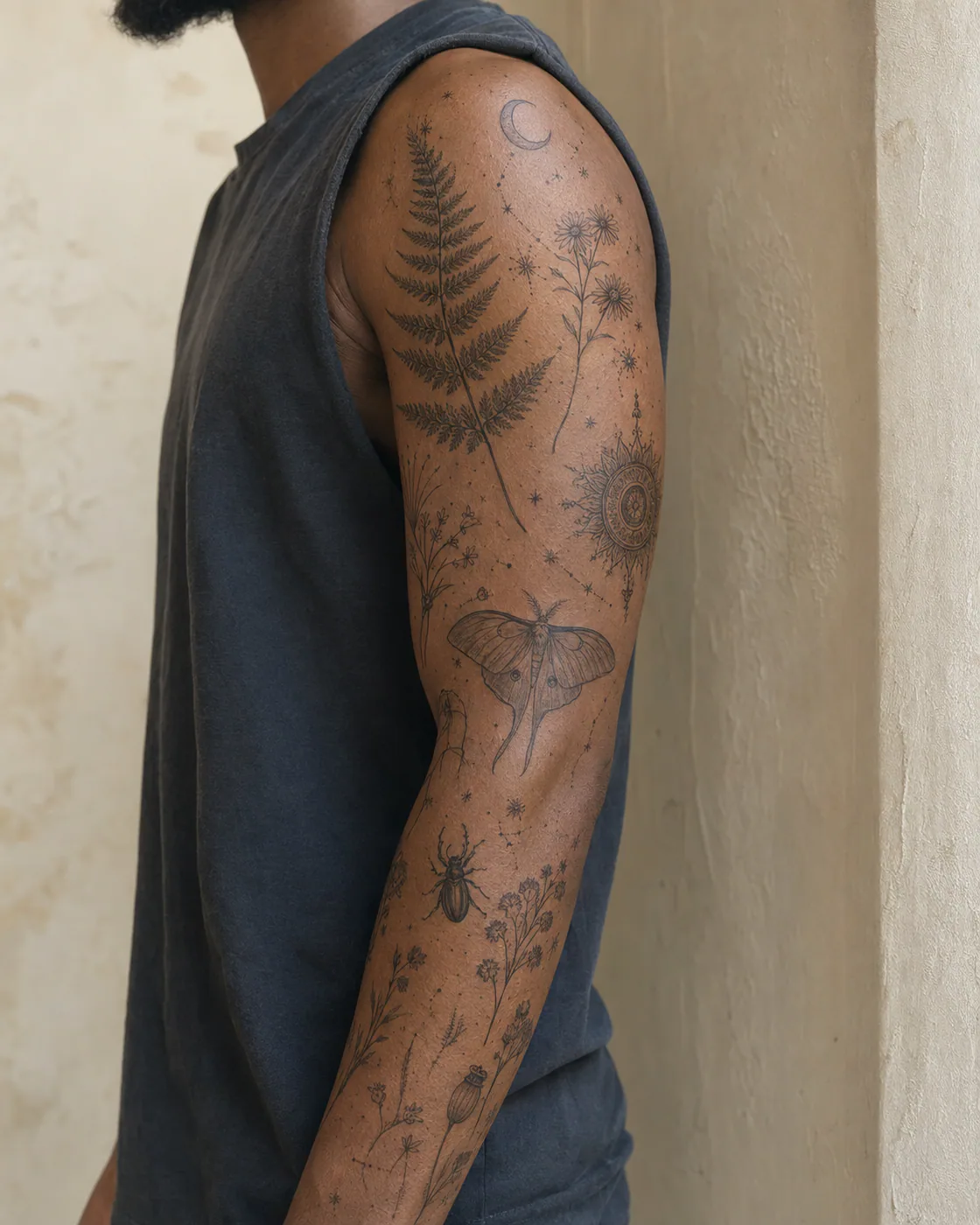
Fern, moth, and crescent fine-line sleeve
Long fern silhouettes guide the eye down the arm while the moth provides a centered, readable anchor.
- Fine Line
- Flowers & Botanicals
- Full sleeve
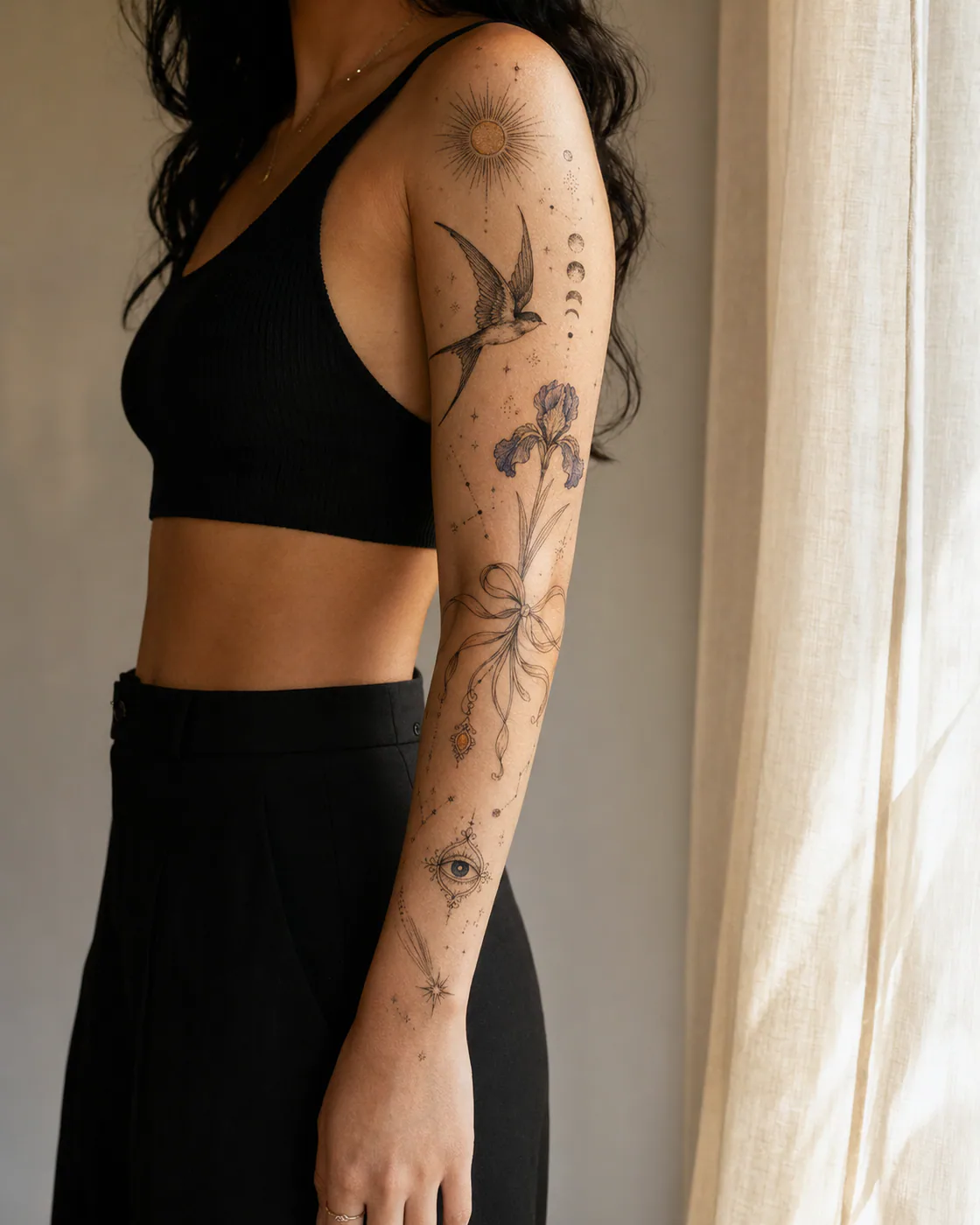
Celestial bird and ribbon orbit
Curved orbital lines repeat around separate motifs, giving the airy collection a subtle shared movement.
- Fine Line
- Celestial
- Full sleeve
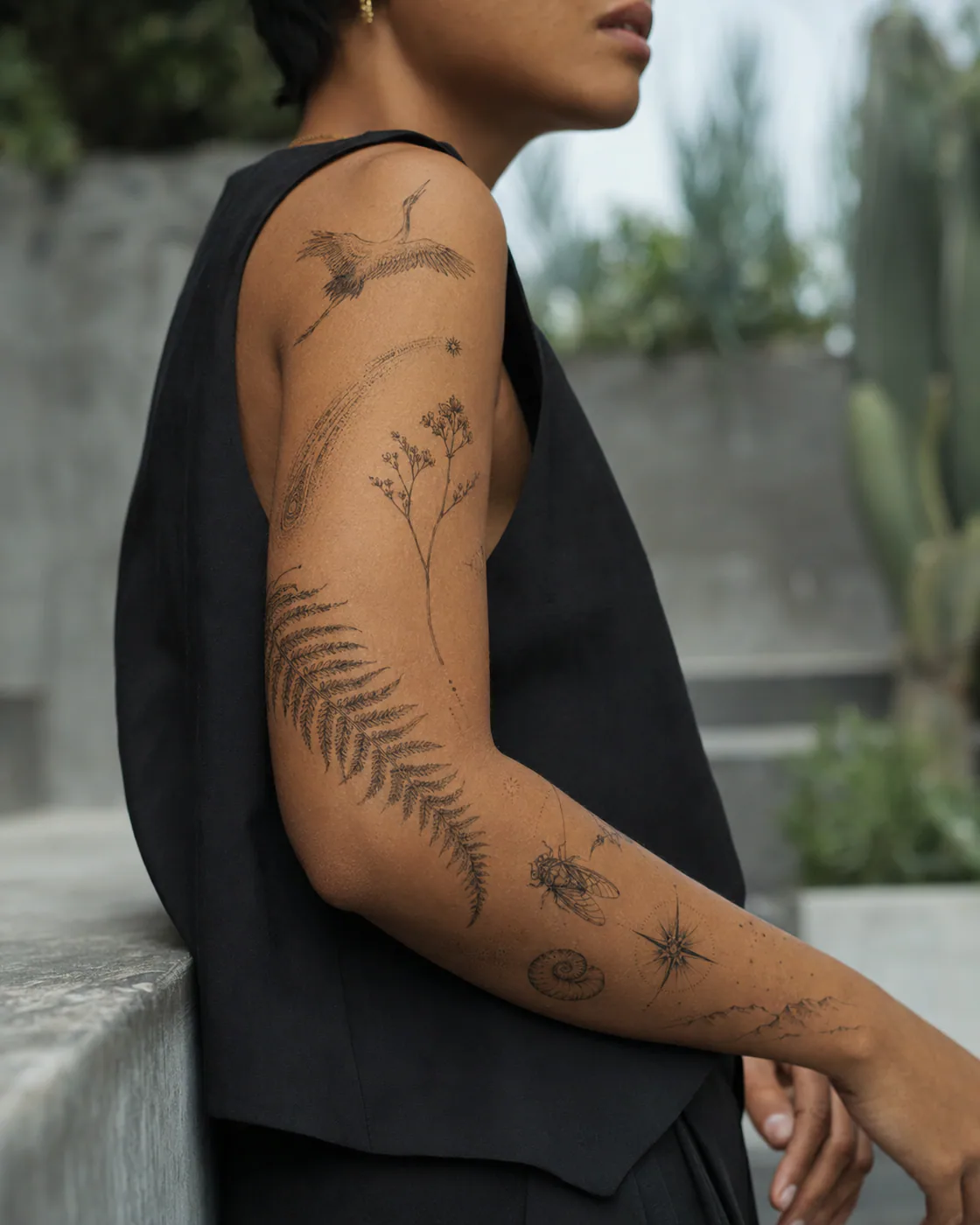
Crane, fern, and comet elbow flow
The fern curves around the elbow while the crane, comet, and smaller nature studies stay readable across changing arm planes.
- Fine Line
- Animals
- Full sleeve
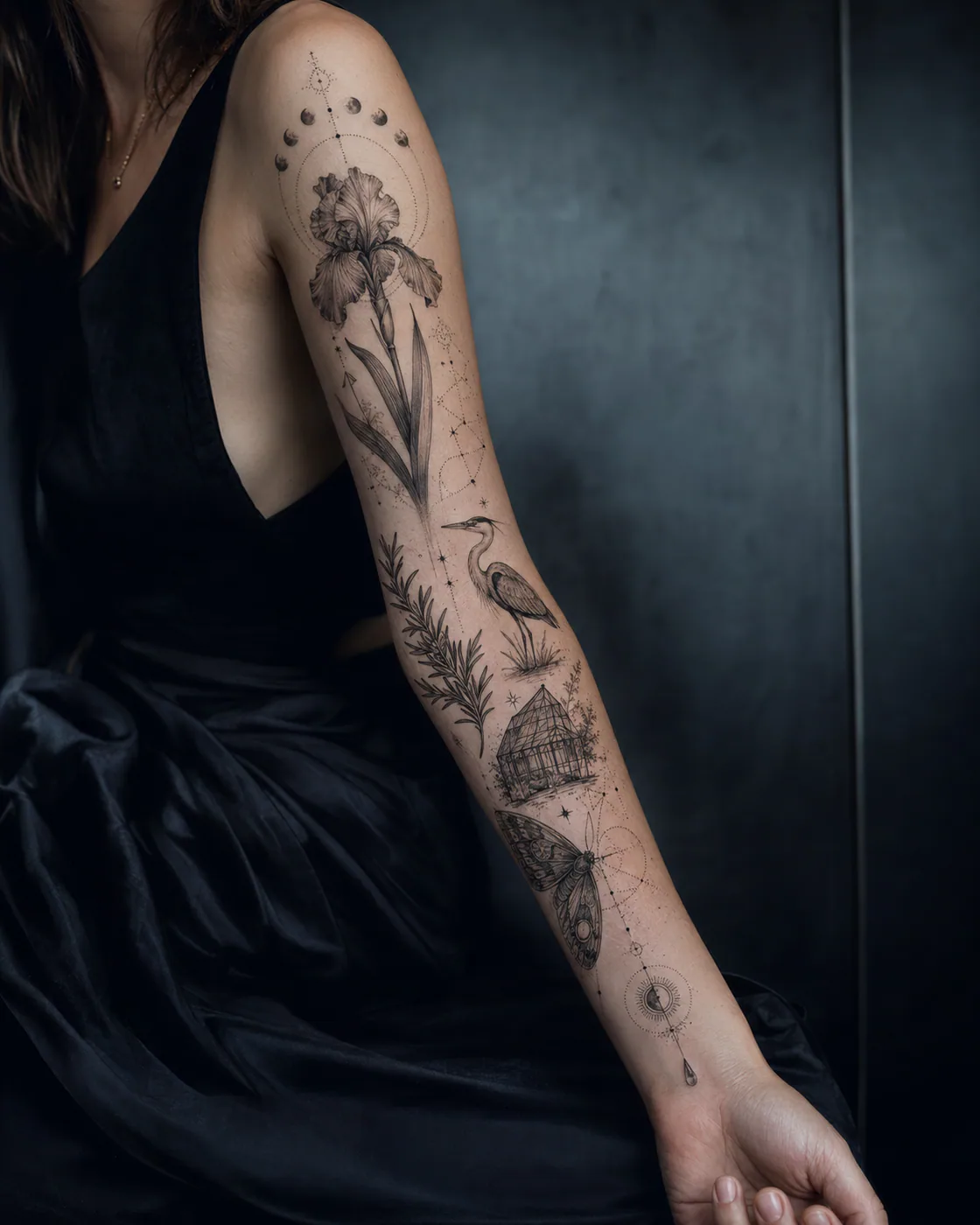
Iris, heron, and moonlight herbarium
The tall iris begins the inner-arm flow, while the heron, glasshouse, moth, and moon phases build a detailed nocturnal herbarium.
- Fine Line
- Flowers & Botanicals
- Full sleeve
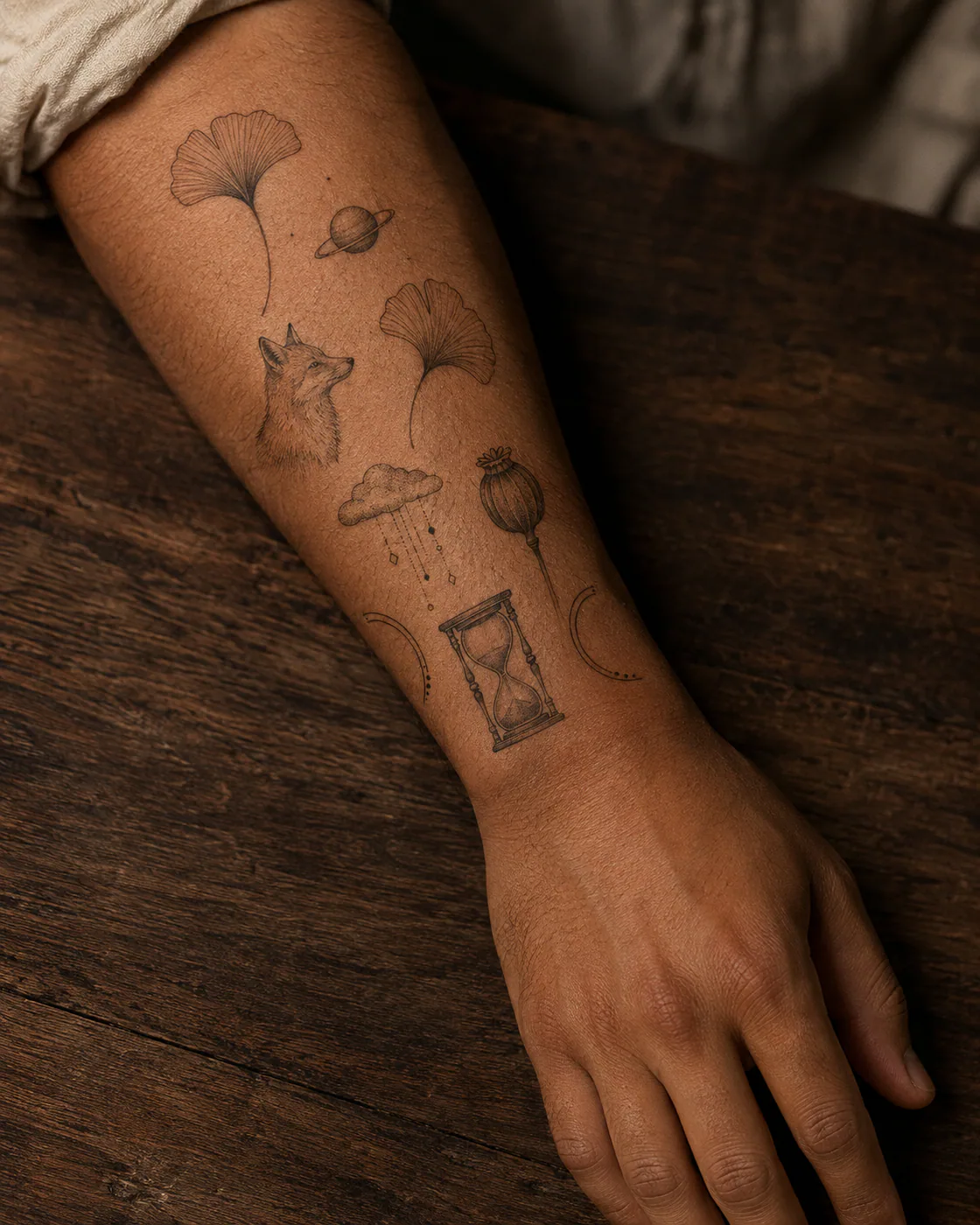
Botanical orbit wrist transition
Ginkgo leaves and small story symbols reduce in scale near the wrist, while open arcs finish the sleeve without a hard visual edge.
- Fine Line
- Flowers & Botanicals
- Full sleeve
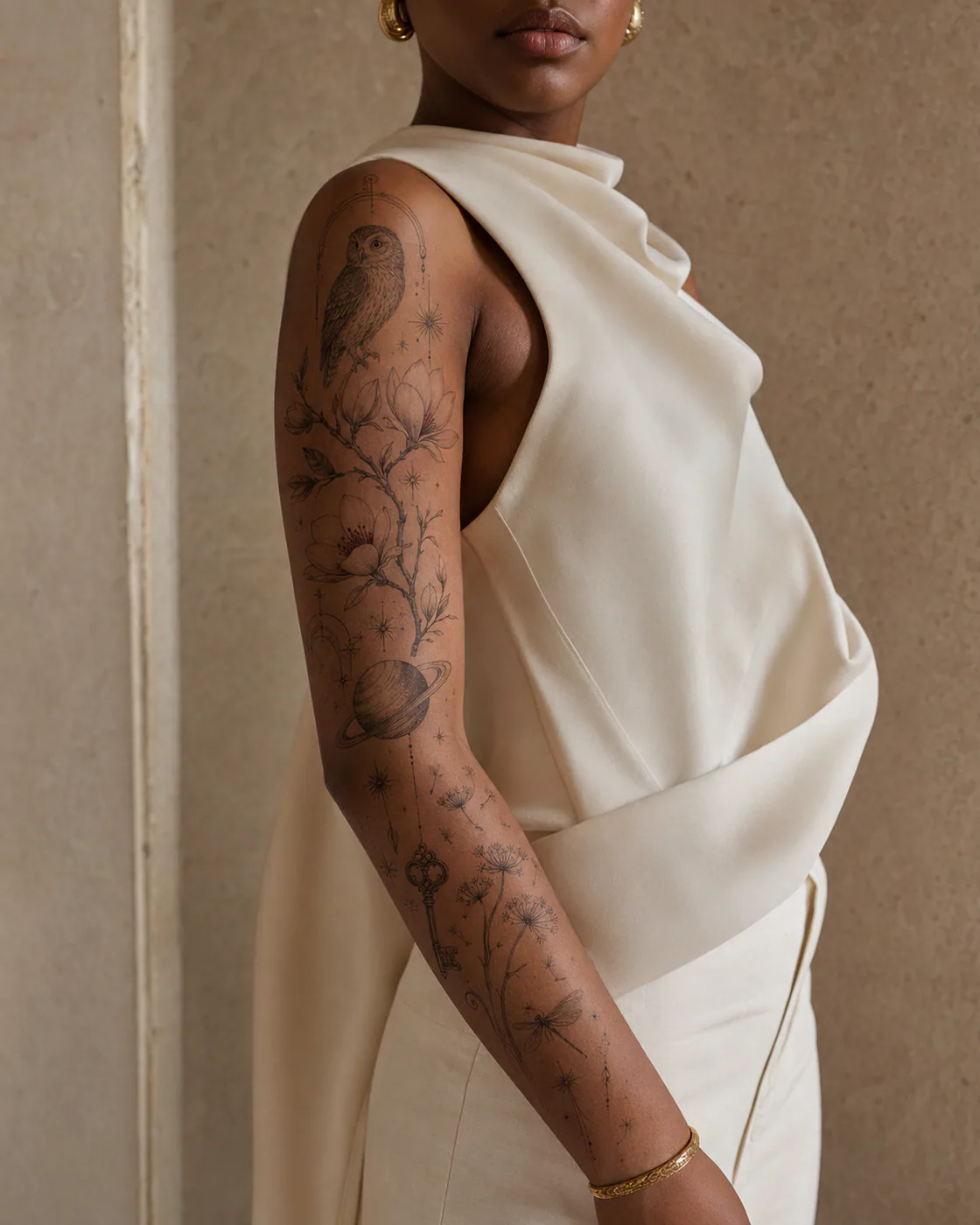
Owl, magnolia, and orbit sleeve
The owl and magnolia establish the upper-arm anchors while the planet, key, and finer symbols step down toward the wrist.
- Fine Line
- Flowers & Botanicals
- Full sleeve
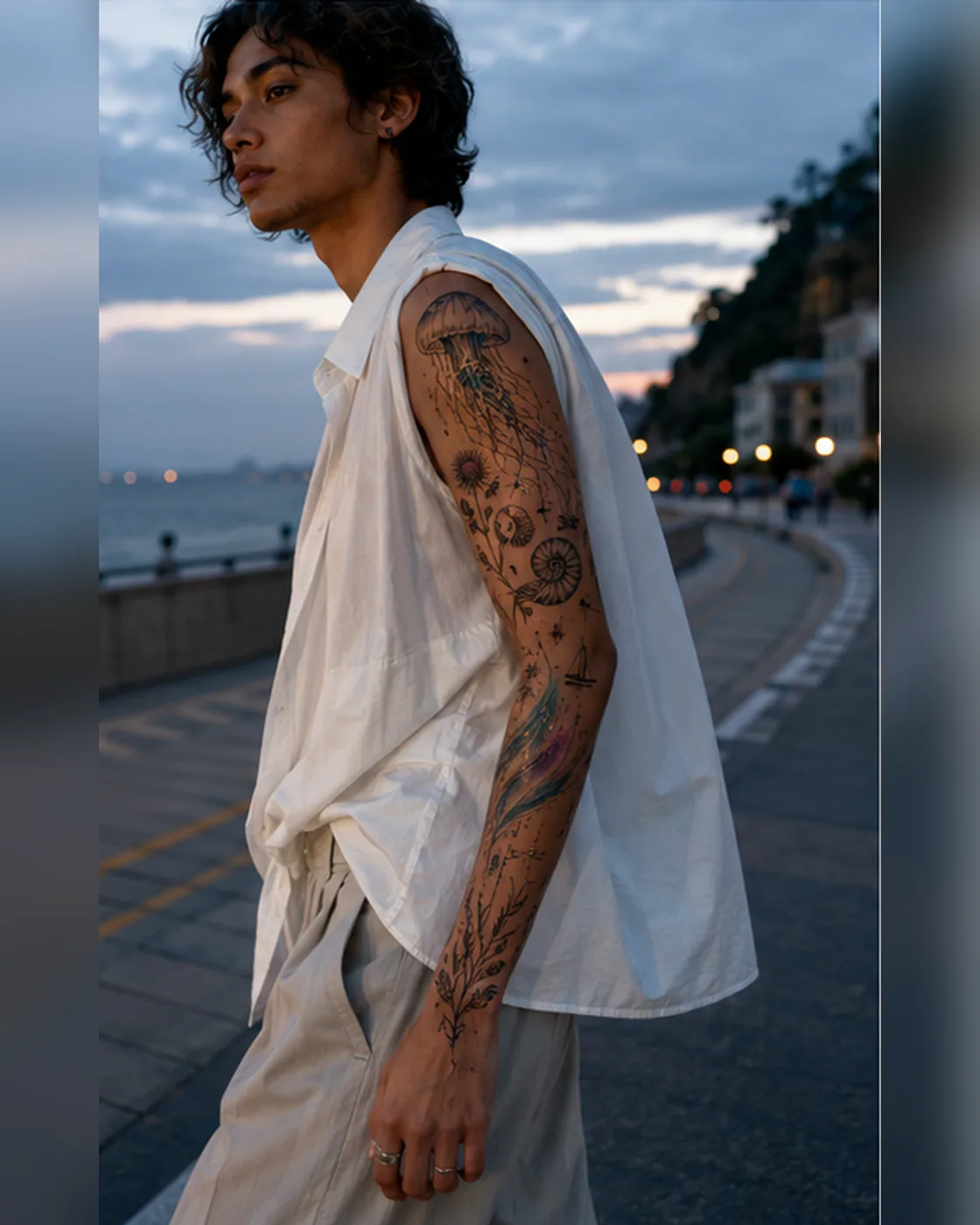
Jellyfish, shell, and celestial tide
A large jellyfish leads the shoulder while shells, sea grass, and restrained color create a moving coastal story down the arm.
- Fine Line
- Animals
- Full sleeve
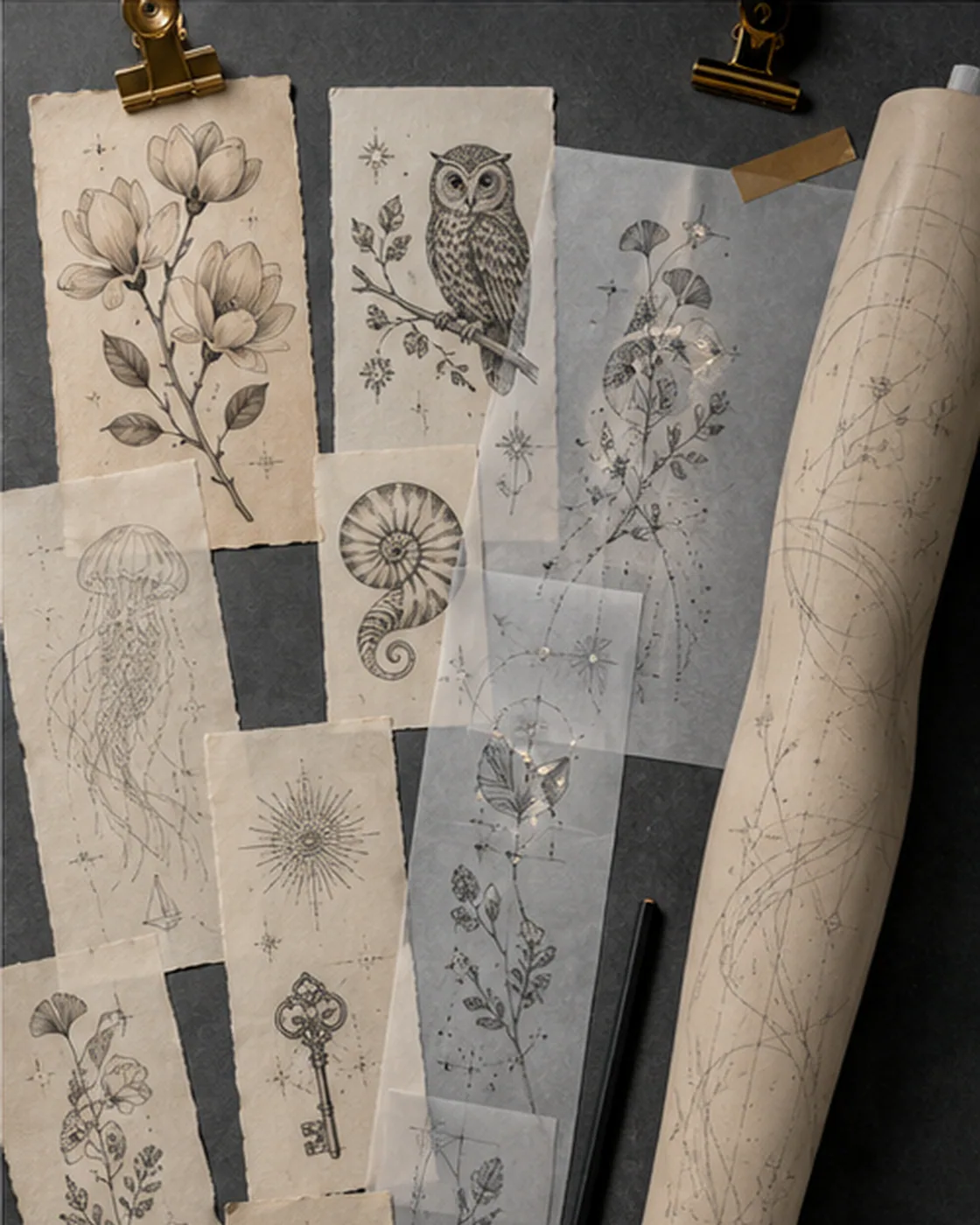
Fine-line botanical and celestial map
The map compares delicate motif sizes and protects enough blank skin for every line to age with space.
- Fine Line
- Flowers & Botanicals
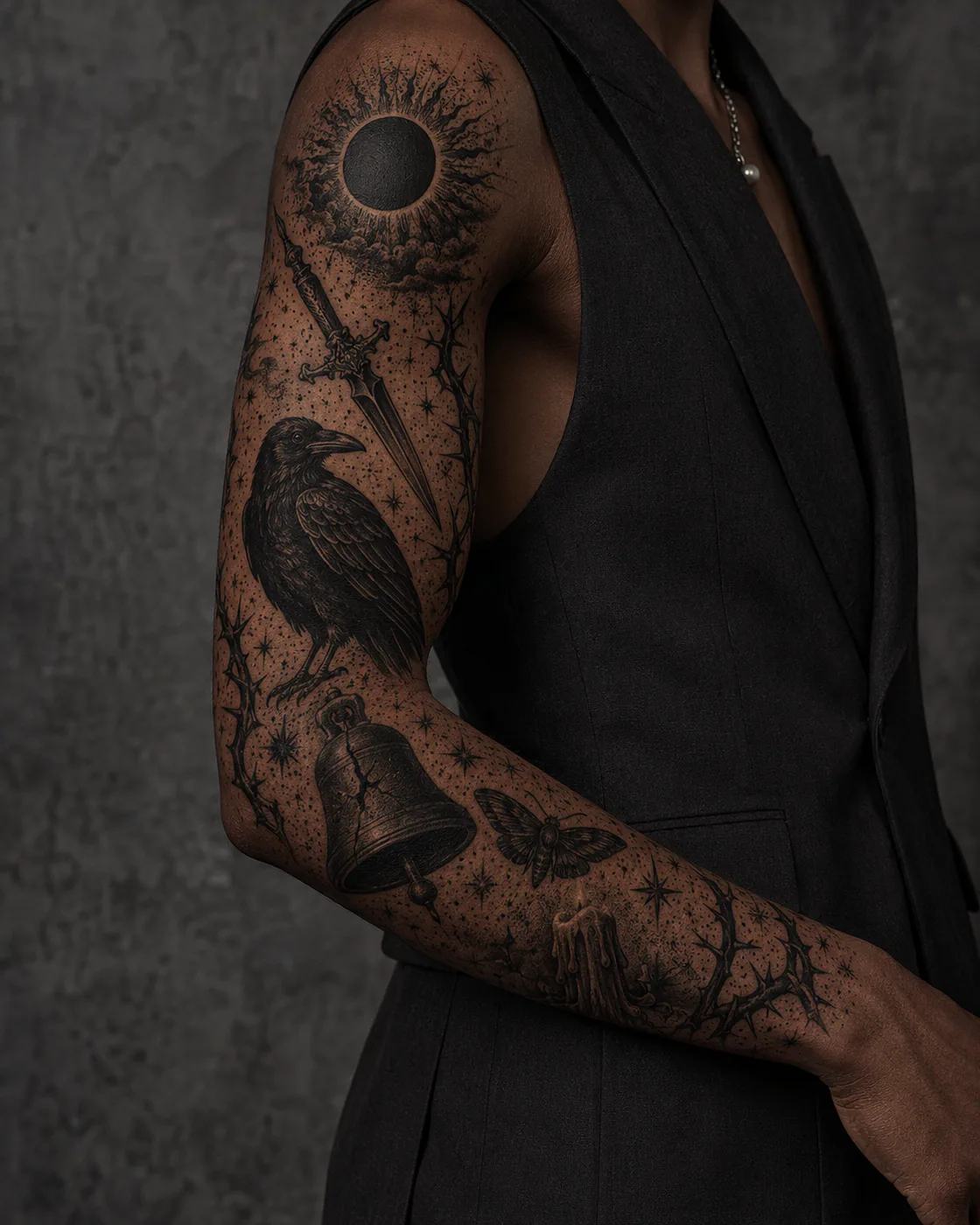
Raven and dagger blackwork sleeve
Dense raven feathers anchor the shoulder while hard-edged symbols step down the arm with measured gaps.
- Blackwork
- Animals
- Full sleeve
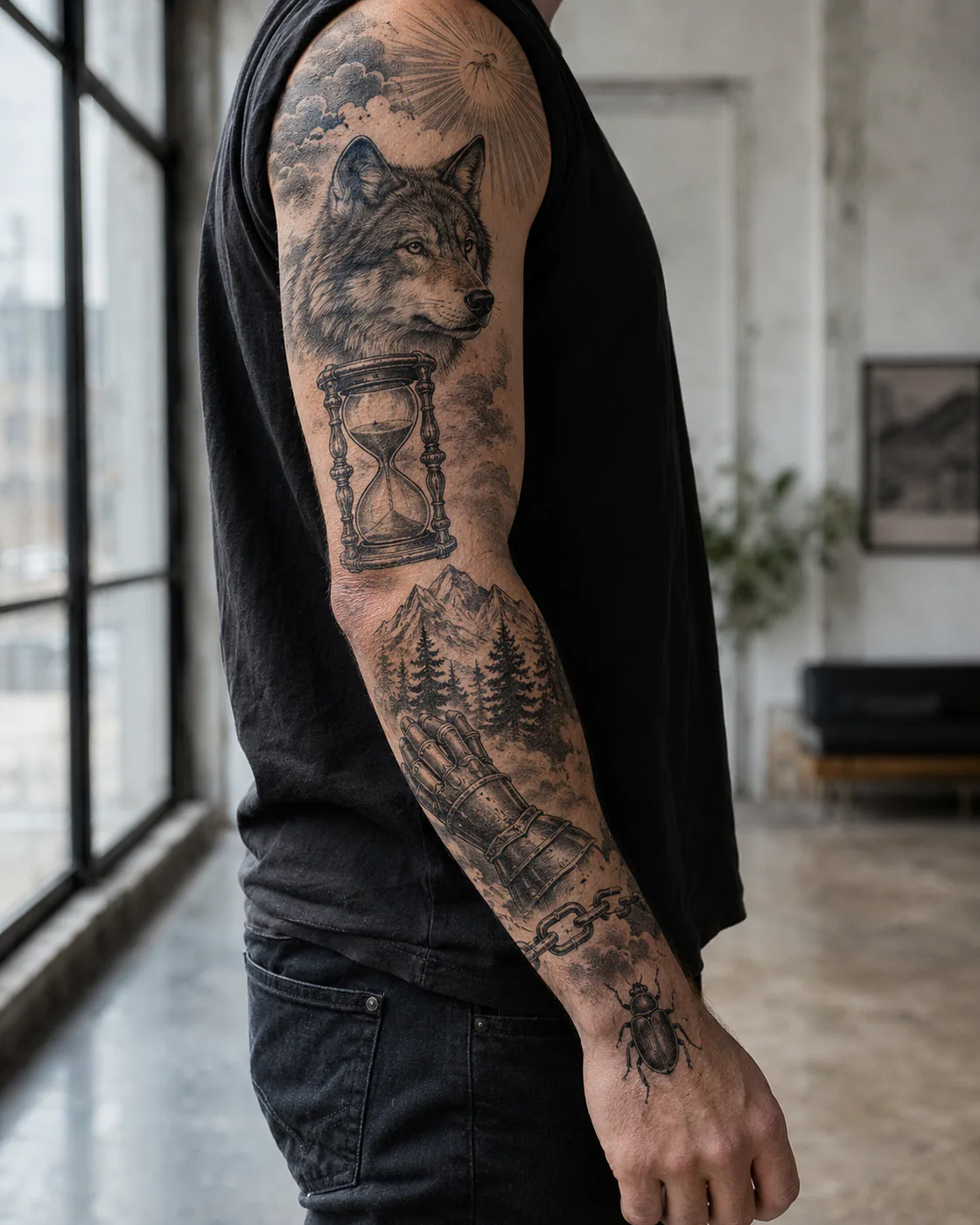
Engraved wolf and hourglass collection
Consistent carved hatching lets narrative subjects of different sizes read like pages from one old book.
- Illustrative
- Animals
- Full sleeve
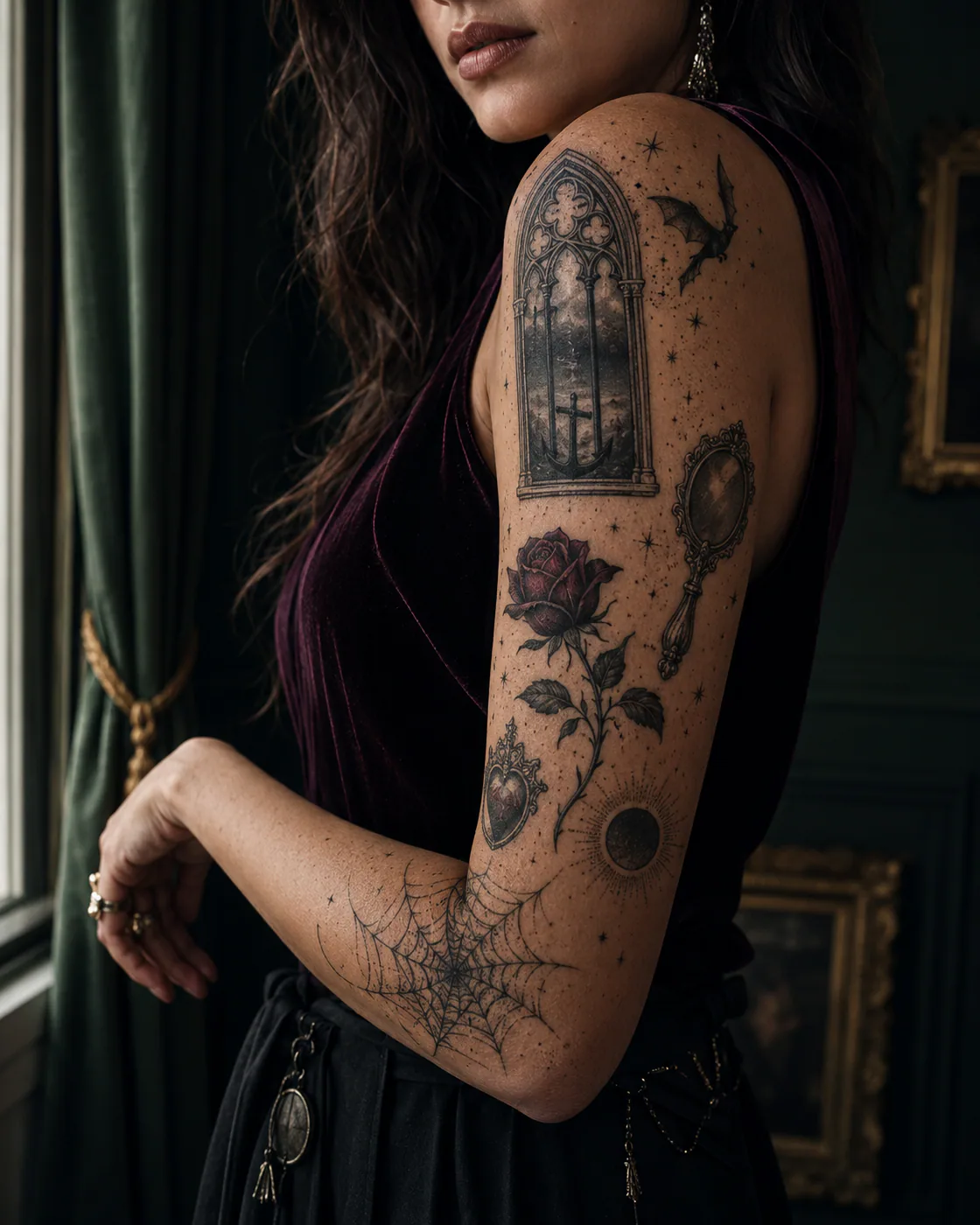
Cathedral, bat, and eclipse sleeve
Pointed architectural forms echo the bat wings and thorns, creating cohesion without using ornamental filler.
- Blackwork
- Gothic
- Full sleeve
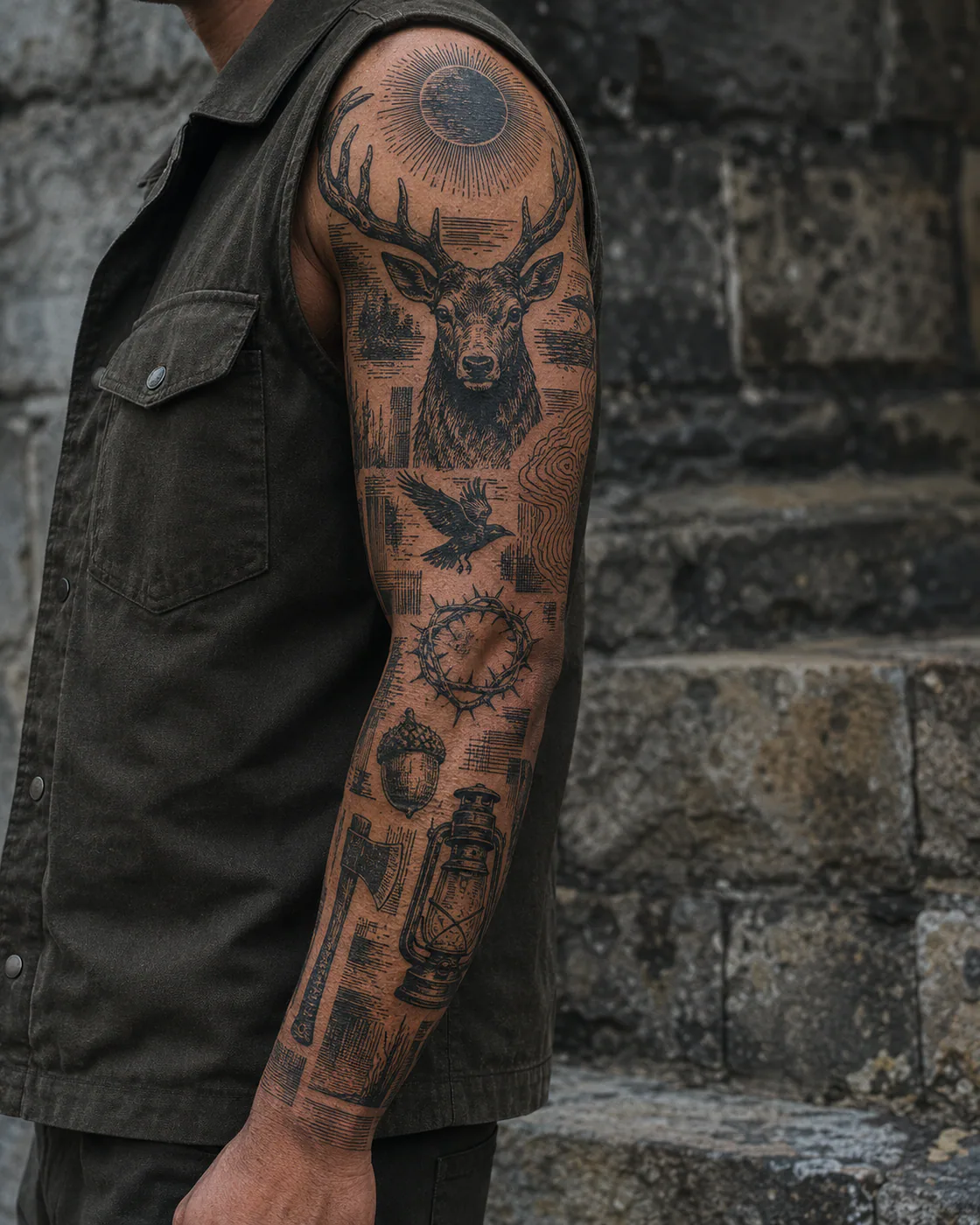
Woodcut stag and thorn bend
Branching antlers occupy the broad upper arm while smaller carved shapes leave the elbow room to move.
- Illustrative
- Animals
- Full sleeve
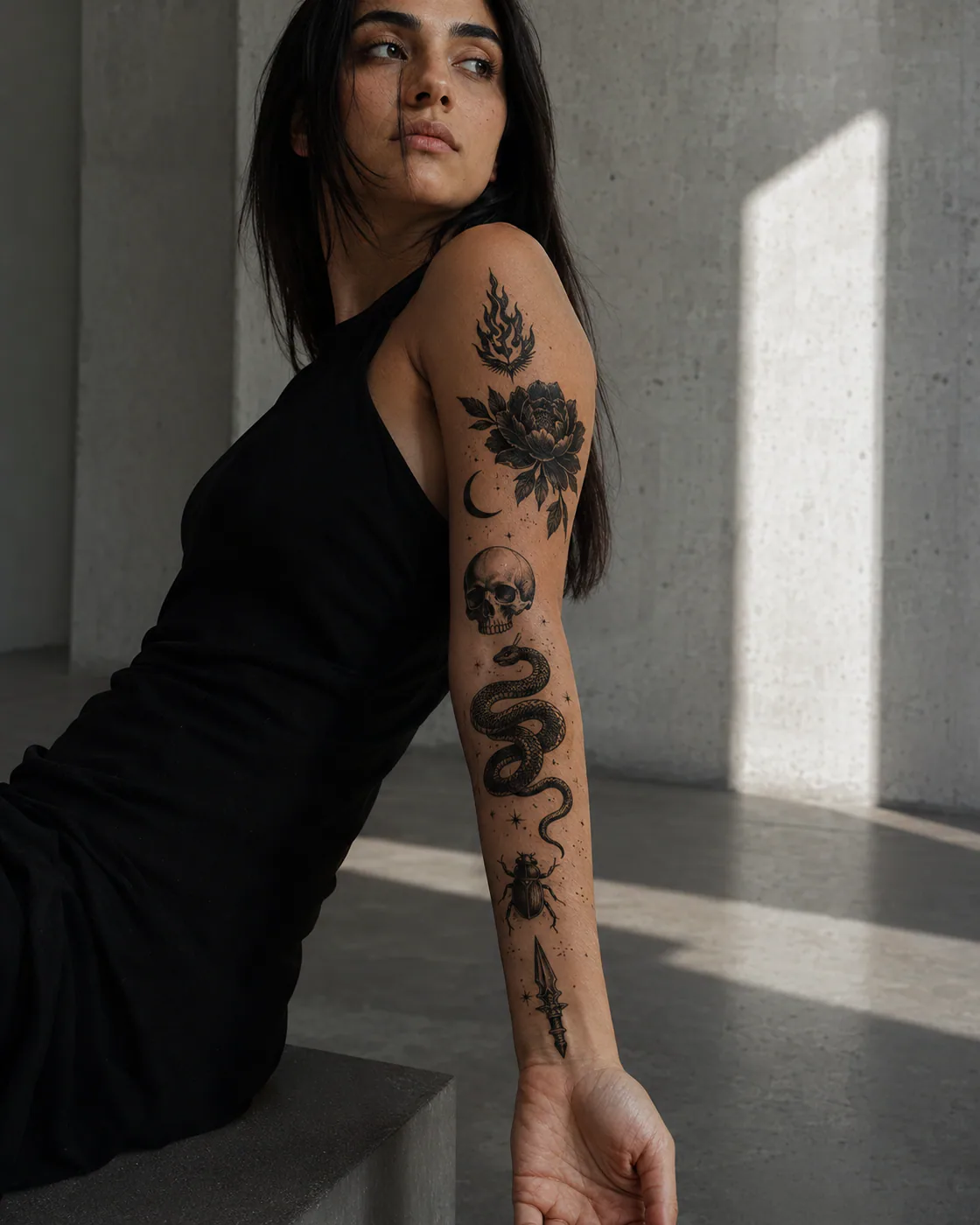
Snake and skull wrist descent
The serpent provides a flexible vertical line, and the smallest solid marks finish the transition above the hand.
- Blackwork
- Animals
- Full sleeve
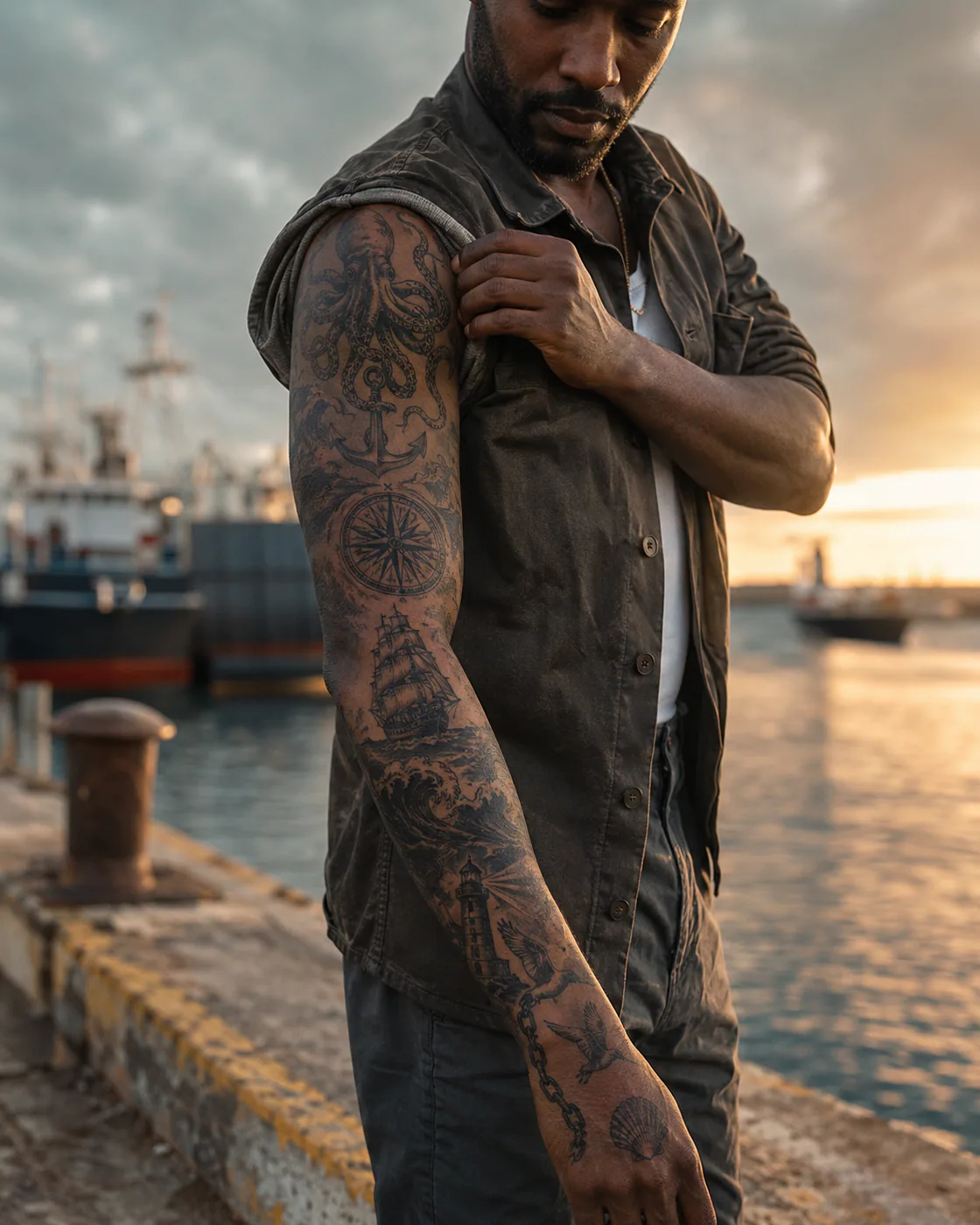
Kraken and compass engraving sleeve
Etched linework keeps a dramatic sea narrative detailed yet open enough for distinct pieces to remain separate.
- Illustrative
- Nautical
- Full sleeve

Armored rose gothic collection
Metallic armor and soft petals alternate hard and organic silhouettes across a disciplined monochrome sleeve.
- Blackwork
- Gothic
- Full sleeve
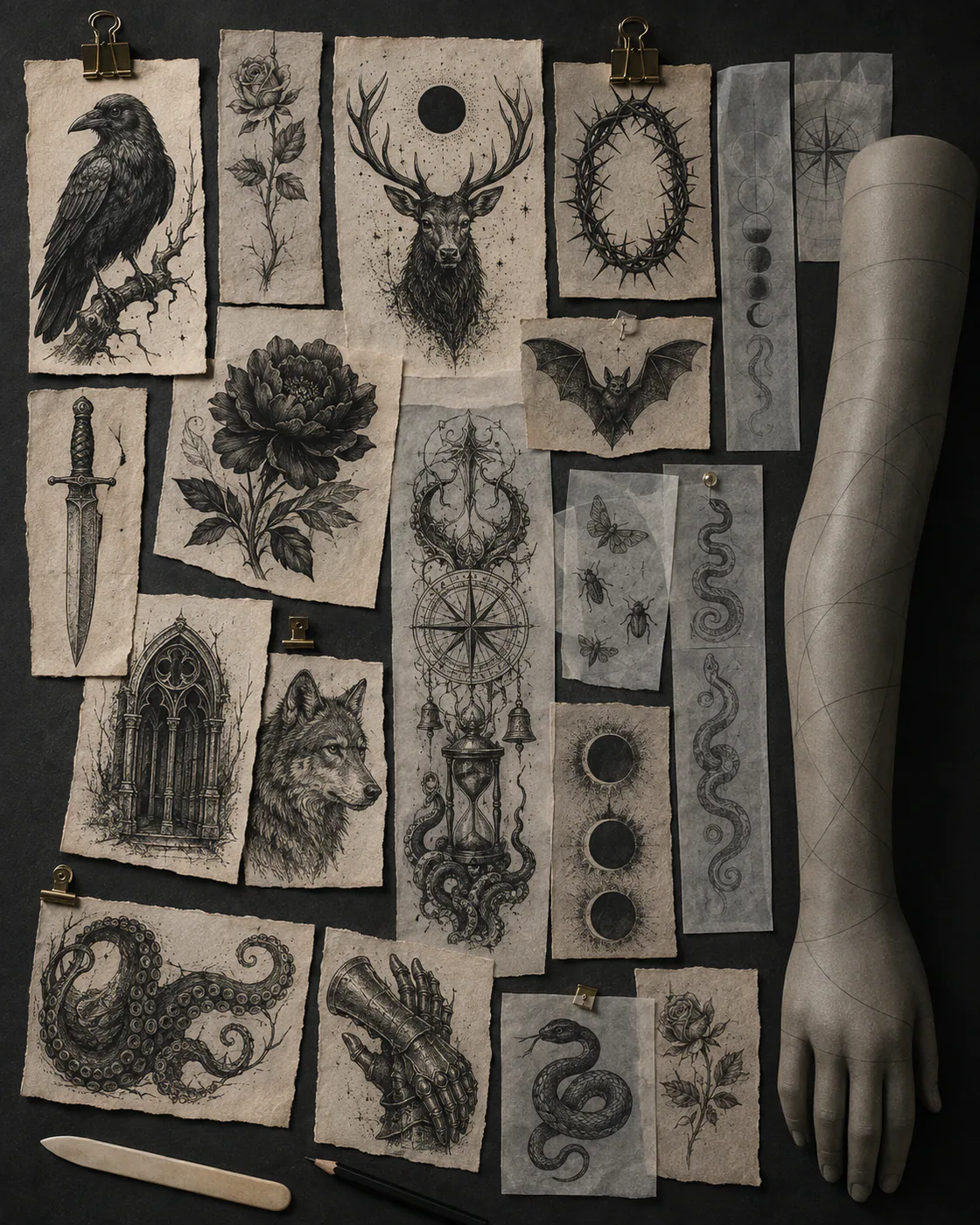
Blackwork and gothic contrast map
The contrast map prevents several dense black anchors from clustering on one side of the finished arm.
- Blackwork
- Gothic
PATCHWORK DIRECTIONS TO EXPLORE
Choose a visual rule before collecting more pieces
Patchwork does not require every tattoo to match. It does benefit from one or two constraints that help very different subjects share the same arm.
American traditional patchwork
Use bold outlines, a controlled color palette, and recognizable flash-scale subjects. Repeated line weight lets animals, flowers, daggers, and symbols coexist without a continuous background.
Fine-line patchwork with breathing room
Keep generous, deliberate gaps around lighter designs. Similar delicacy is not enough on its own; vary silhouette and scale so the collection does not dissolve into visual noise.
Blackwork anchors and quieter companions
Place two or three darker anchor pieces around the upper arm and forearm, then use smaller, less dense tattoos to balance the remaining spaces.
A limited color system
If the subjects and artists vary, repeat two or three accent colors. A restrained palette can create family resemblance without making every piece look identical.
Story-led collected symbols
Build around places, people, milestones, hobbies, and objects that matter to you. A personal theme can connect mixed styles more naturally than a decorative filler pattern.
Mixed styles with planned boundaries
Different styles can work together when each piece has a clear silhouette and enough territory. Avoid letting one highly rendered image crowd several delicate neighboring tattoos.
MAKE SEPARATE PIECES FEEL DELIBERATELY COLLECTED
Compare four ways to build a coherent patchwork sleeve
Patchwork sleeves use standalone tattoos rather than one continuous scene. Cohesion can come from spacing, line weight, palette, subject relationships, or a later connecting treatment; those choices should be intentional.
Patchwork system: Open-space sticker collection
- Often works well for
- Clearly separated flash, personal icons, and a sleeve intended to grow over years.
- Layout cue
- Large anchors first, then medium pieces and small gap-specific additions with visible skin.
- What to check
- Keep spacing rhythm consistent and resist filling every gap before the main pieces are placed.
Patchwork system: Single-style patchwork set
- Often works well for
- Traditional, fine-line, engraving, blackwork, or another shared visual language.
- Layout cue
- Varied piece sizes unified by related line weight, shading, or color behavior.
- What to check
- Avoid making every piece the same size; hierarchy helps the collection read across the arm.
Patchwork system: Curated mixed-style sleeve
- Often works well for
- Collections from different artists, periods, or subjects that are meant to retain contrast.
- Layout cue
- A planned mix of anchors and supporting pieces linked by repeated visual cues.
- What to check
- Choose at least one unifier, such as palette, spacing, edge weight, or recurring subject shape.
Patchwork system: Connected patchwork background
- Often works well for
- Existing collections that need a stronger overall field through dots, stars, smoke, or shading.
- Layout cue
- Supporting filler distributed around completed pieces without overpowering their silhouettes.
- What to check
- Add filler late and let one artist map the full arm; more ink is not automatically more cohesion.
PLAN THE WHOLE ARM
How to build a patchwork sleeve in a useful order
You do not need to design every tattoo at once, but you should reserve important zones before spontaneous additions make the arm difficult to balance.
Map anchor zones first
Reserve the shoulder cap, outer upper arm, elbow area, and broad forearm faces for the pieces that need the most room or visibility.
Choose a spacing range
Ask your artist to mark a consistent minimum gap in centimeters. Equal spacing is not mandatory, but accidental near-collisions quickly make a sleeve feel cramped.
Check the arm in rotation
Front-facing mockups hide collisions on the inner arm and around the elbow. Review the plan from several angles with the arm relaxed and bent.
Leave filler until late
Stars, dots, smoke, leaves, and tiny symbols should solve specific leftover spaces. Adding filler too early removes the flexibility future anchor pieces need.
ARTIST HANDOFF
Bring an arm map, not only a folder of references
A good consultation covers what is already tattooed, which zones must stay open, how much contrast you want, and whether one artist or several artists will shape the collection.
Include in your patchwork brief
- Clear photos of the entire arm from the front, back, inner, and outer views.
- The dimensions and dates of existing tattoos, including any that may need reworking.
- Two or three preferred anchor subjects and the personal reason behind each one.
- A line-weight and color rule that future pieces should broadly follow.
- A list of arm zones that should remain empty for later additions.
KEEP EXPLORING
Related tattoo idea collections
Use another placement, size, audience, or subject to make your direction more specific.

Tattoo Sleeve Ideas
Plan a cohesive full, half, or patchwork sleeve through hierarchy, body flow, transitions, and a realistic session roadmap.
Explore the collection
Forearm Tattoo Ideas
Compare inner, outer, wraparound, and vertical forearm compositions designed for movement and everyday visibility.
Explore the collection
Small Tattoo Ideas
Find compact concepts designed around clear silhouettes, selective detail, and enough space to remain readable.
Explore the collectionCOMMON QUESTIONS
What to know before choosing this direction
What is a patchwork sleeve tattoo?
It is a sleeve assembled from separate, individually readable tattoos with visible skin between them. It is often called a sticker sleeve. “Random tattoo sleeve” is an informal search term, but thoughtful spacing and scale keep a strong patchwork sleeve from looking random.
How do you make a patchwork sleeve look cohesive?
Repeat a few rules such as line weight, spacing, color accents, or subject mood. Consistency in every category is unnecessary, but the arm needs enough shared visual rhythm to avoid accidental clutter.
Where should a patchwork sleeve start?
Start with one or two anchor pieces in high-value zones such as the upper arm or broad forearm. Map the entire arm before placing small tattoos in spaces that larger ideas may need later.
Does a patchwork sleeve need filler?
No. Visible skin is part of the style. Add filler only when a specific gap disrupts the overall balance, and wait until most major pieces are complete before deciding.
Can multiple artists work on one patchwork sleeve?
Yes. Save measurements, healed photos, palette notes, and spacing rules so each artist can understand the existing collection. One coordinating artist can help review the full arm plan.
What is the difference between a patchwork sleeve and a cohesive sleeve?
A patchwork sleeve preserves separate, individually readable tattoos and visible gaps. A cohesive sleeve is usually planned as one connected composition with shared background, movement, or transitions. Either can feel intentional; the difference is how the pieces relate across the arm.
How much space should patchwork tattoos have between them?
There is no universal gap. The right spacing depends on each tattoo’s scale, silhouette, line weight, the shape of the arm, and whether filler may be added later. Ask your artist to map several consistent spacing options directly on the arm before committing.
TURN INSPIRATION INTO AN ORIGINAL CONCEPT
Keep designing with your own story
Take the subject, placement, and style into the AI generator, then use virtual try-on to judge approximate scale. A tattoo artist should still redraw the final design for your body.